
DbcultAccessing Vault...
Director's Spotlight
Senior Film Conservator
Director's Spotlight: United States
A Deep Dive into the 1923 Vision of Eugene De Rue
Few works in United States cinema carry the same weight as All Is Lost, especially regarding the cultural zeitgeist captured so perfectly by Eugene De Rue in 1923. Utilizing a 1923-specific aesthetic that remains timeless, it serves as a blueprint for future generations of Comedy directors.
In All Is Lost, Eugene De Rue pushes the boundaries of conventional narrative. The film's unique approach to its subject matter has sparked endless debates and interpretations among cinephiles and critics alike.
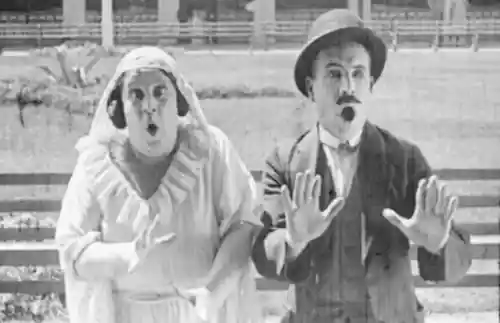
In this work, Eugene De Rue explores the intersection of Comedy and United States cultural identity. The meticulous attention to detail suggests a deep-seated commitment to pushing the boundaries of the medium, ensuring that All Is Lost remains a relevant topic of study for Comedy enthusiasts.
| Cinematography | Noir-Inspired |
| Soundtrack | Synth-Heavy |
| Editing | Rhythmic |
| Art Direction | Naturalist |
Visualizing the convergence of Eugene De Rue's style and the core Comedy narrative.
Bobby Dunn wants to get married. He has found the girl, and though, fat and forty, she is perfectly willing for the ceremony to take place. It all rests with mother, and she decides that her son-in-law must have at least ten dollars. Bobby has only two so it's all off. Broken hearted, he leaves the house and on his arrival home he is telephoned that mother has changed her mind, and to meet them at the church in ten minutes. Unfortunately, he is delayed by a roughneck and he arrives too late. He tries to give an explanation but it is not accepted. The only thing to do is to die. Hurrying back to the man who delayed him, he offers him the two dollars to kill him painlessly. The man tries his best, but Bobby bears a charmed life. Meanwhile at the girl's house, her brother has arrived from Montana, Having heard that his sister is about to be married, he has called with the intention of taking them both back to his ranch. They take a walk, and turning a corner they see Bobby just about to be shot by the hired assassin. Stepping between them, she tells Bobby that she cannot let him die and they will be married at once. Here the brother interrupts and tells her that as the roughneck will be of more use to him on the farm she had better marry him. To Bobby's dismay, she agrees. Bobby looks around once more for a means of committing suicide.
Decades after its release, All Is Lost remains a vital piece of the cinematic puzzle. Its influence can be seen in countless modern works, solidifying Eugene De Rue's status as a master of the craft in United States and beyond.