
DbcultAccessing Vault...
Director's Spotlight
Senior Film Conservator
Director's Spotlight: United States
A Deep Dive into the 1922 Vision of Eugene De Rue
The brilliance of Give Me Air (1922) is inseparable from the visionary mind of its creator, Eugene De Rue. Serving as a mirror to the anxieties of a changing world, it persists as a haunting reminder of our own cinematic history.
In Give Me Air, Eugene De Rue pushes the boundaries of conventional narrative. The film's unique approach to its subject matter has sparked endless debates and interpretations among cinephiles and critics alike.
To fully appreciate Give Me Air, one must consider the cinematic climate of 1922. During this period, United States was undergoing significant artistic shifts, and Eugene De Rue was at the forefront of this Short movement, often challenging established norms.
| Cinematography | Noir-Inspired |
| Soundtrack | Diegetic |
| Editing | Rhythmic |
| Art Direction | Naturalist |
Visualizing the convergence of Eugene De Rue's style and the core Short narrative.
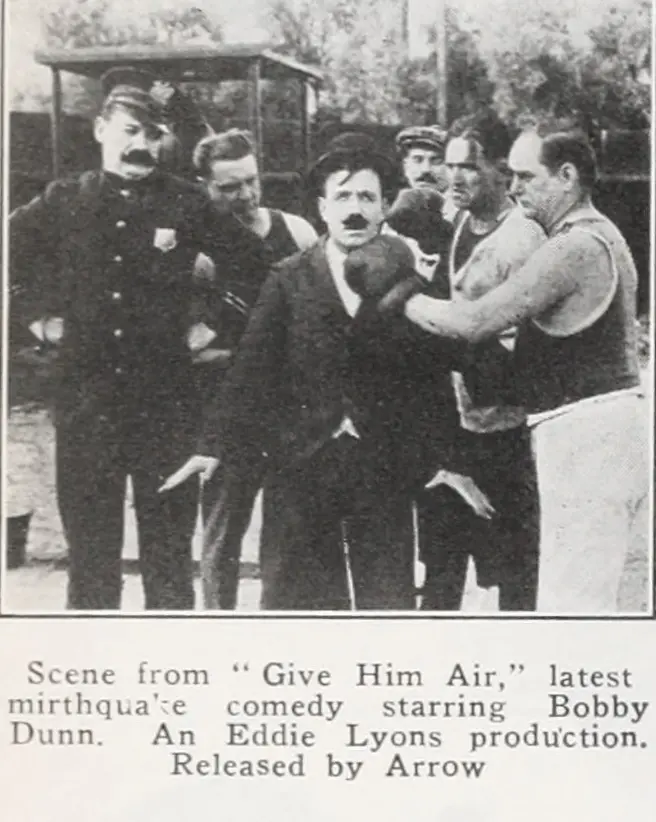
Bobby Dunn has been shipped out of one city by the sheriff, for the reason that he absolutely refuses to work and is therefore considered undesirable as a citizen. He arrives in a mail sack and the sheriff immediately tries to see to it that he gets work, but Bobby is successful in eluding job after job until finally, in his attempt to escape, he lands in a training camp where a heavy-weight. prize fighter is getting ready for a championship battle. The fighter, badly in need of sparring partners, takes Bobby on and knocks him out with the first punch. While out, Bobby dreams that he is so successful that he becomes the fighter's manager and trains him for the fight. The fighter has a very attractive sister with who Bobby falls in love. On the day of the fight the fighter falls and breaks his arm and Bobby says that he will go into the ring in his stead. He does, when to his horror he finds that his opponent is the official who has been causing him so much trouble. He gets very much the worst of the fight until he succeeds in grabbing a hammer and stuffing it into his glove, promptly knocks out everybody in the ring and the entire audience. The girl, very much impressed, embraces him and he wakes up to find that it was only a dream and the disgusted sheriff puts him back in the mail sack and ships him back to the city from which he came.
Decades after its release, Give Me Air remains a vital piece of the cinematic puzzle. Its influence can be seen in countless modern works, solidifying Eugene De Rue's status as a master of the craft in United States and beyond.