
DbcultAccessing Vault...
Director's Spotlight
Senior Film Conservator
Director's Spotlight: United States
A Deep Dive into the 1922 Vision of Eugene De Rue
As we revisit the 1922 masterpiece No Luck, we are struck by the meticulous attention to detail that Eugene De Rue applied to every frame. Anchored by a narrative that is both personal and universal, it bridges the gap between traditional Short and contemporary vision.
In No Luck, Eugene De Rue pushes the boundaries of conventional narrative. The film's unique approach to its subject matter has sparked endless debates and interpretations among cinephiles and critics alike.
While deeply rooted in United States, No Luck has achieved a global reach, influencing directors from various backgrounds. Its ability to translate Short tropes into a universal cinematic language is why it remains a cult staple decades after its 1922 release.
| Cinematography | Deep Focus |
| Soundtrack | Orchestral |
| Editing | Invisible |
| Art Direction | Kitsch |
Visualizing the convergence of Eugene De Rue's style and the core Short narrative.
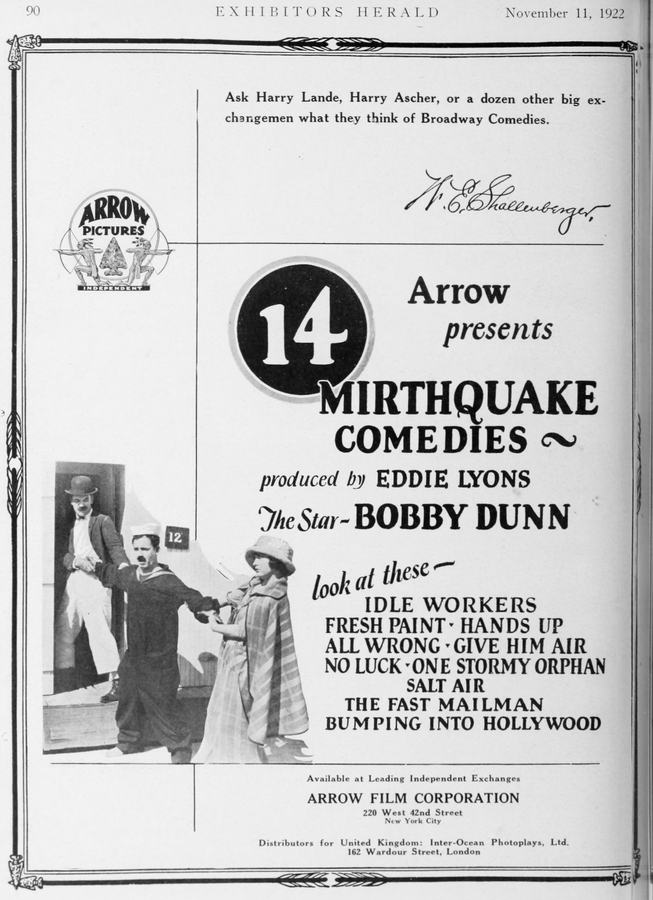
Bobby, thrown out of his boarding house walks along the street carrying all his worldly possessions in a suitcase, bumps into a crook carrying a suit case of stolen jewels. The two suitcases (being alike in appearance) get mixed - Bobby getting the one containing the jewels. Realizing that detectives are after him he tries various ways to dispose of the troublesome suitcase. Whether he drops it on the street, or throws it on a passing trolley or auto truck, always the unwelcomed suitcase returns to him. As a last resort he throws it in a back yard, but a little dog picks it up in his mouth and "dogs" Bobby's very footsteps with it until he has to relieve him of it. Then the crook comes along and takes the suit case away from Bobby. Two detectives are working on the case, one a very charming young lady. Bobby immediately joins forces with her and between them they get the suitcase and return it to Smith and Co. (the people who have been robbed), only to find upon opening that it contains nothing but Bobby's old clothes. Suddenly the little dog is seen carrying the stolen suitcase containing the jewels, and Bobby and the lady give him a lively chase before they recover it from him. Luck turns and Bobby captures the crook, turns him over to the lady detective to arrest. The other detective working on the case gets jealous and decides he also must make an arrest just for the look of things, so he places the handcuffs on Bobby and takes him to jail.
Decades after its release, No Luck remains a vital piece of the cinematic puzzle. Its influence can be seen in countless modern works, solidifying Eugene De Rue's status as a master of the craft in United States and beyond.