
DbcultAccessing Vault...
Director's Spotlight
Senior Film Conservator
Director's Spotlight: United States
A Deep Dive into the 1937 Vision of Ewing Scott
When we examine the cinematic landscape of United States, Hollywood Round-Up emerges as a landmark work of the enduring legacy of Ewing Scott's artistic contribution to the genre. Through a lens of existential fatalism and Drama tropes, it captures a specific kind of cinematic magic that is rarely replicated.
In Hollywood Round-Up, Ewing Scott pushes the boundaries of conventional narrative. The film's unique approach to its subject matter has sparked endless debates and interpretations among cinephiles and critics alike.
In this work, Ewing Scott explores the intersection of Drama and United States cultural identity. The meticulous attention to detail suggests a deep-seated commitment to pushing the boundaries of the medium, ensuring that Hollywood Round-Up remains a relevant topic of study for Drama enthusiasts.
| Cinematography | Noir-Inspired |
| Soundtrack | Diegetic |
| Editing | Elliptical |
| Art Direction | Expressionist |
Visualizing the convergence of Ewing Scott's style and the core Drama narrative.
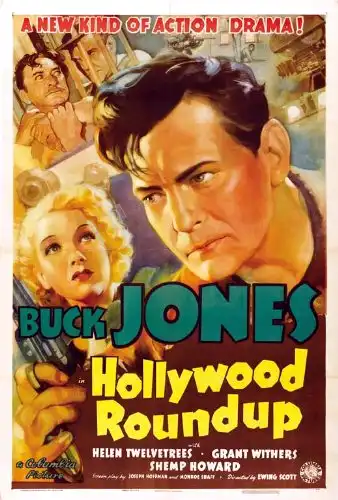
One of three films made by Columbia circa 1936-37 based on behind-the-scenes film making with a "western" setting ("The Cowboy Star", "Hollywood Round-up" and "It Happened in Hollywood"), plus RKO weighed in the same year with George O'Brien's "Hollywood Cowboy." It had been done before, RKO's 1933 "Scarlet River", and would be done again, "Shooting High" from 20th Century-Fox and Republic's "Bells of Rosarita", among others with a western setting, but this Coronet production with Buck Jones may well be the best of the lot as it devotes more footage to actual film-making both on studio sets and locations. One out-of-the norm plot incident has the studio head Lew Wallace offering a job to a fading star Carol Stevens, with a semi-apology for casting her in what he calls an "outdoor special" and she calls a "horse opry", and this scene in a B-western leaves no doubt that the B-western and it people were near the bottom of Hollywood's pecking order. The stereotypes are there, with Shemp Howard's over-zealous "assistant director" (who does calm down and gets more real when he loses his whistle), the ego-ridden "star" in Grant Drexel, and the deserving-to-be-the-star relegated to stand-in and stunts Buck Kennedy, but the remaining crew and player roles are realistic (especially the real stuntmen playing stuntmen). Buck Kennedy is the stand-in and double for star Grant Drexel and is fired when he has a fight with the bullying Drexel over Drexel's treatment of leading lady Carol Stephens. The movie company is on location, and a group of gangsters led by Eddie Kane and Lester Dorr, posing as another movie company, come to the location town and talk the banker into letting them film a fake holdup in his bank, but the holdup is real and the out-of-work Buck, whom they hire as the fall guy to cover their getaway, is left holding the bag and jailed by town sheriff Slim Whitaker. Things get worse for Buck before they get better. A mid-point sequence has hotel clerk George A. Beranger, who dreams of being a western star, performing a twittering, ballet-slippering audition for the checking-in film company by quoting lines from a western and asking them to identify the film. Shemp Howard guesses "Little Women."
Decades after its release, Hollywood Round-Up remains a vital piece of the cinematic puzzle. Its influence can be seen in countless modern works, solidifying Ewing Scott's status as a master of the craft in United States and beyond.