
DbcultAccessing Vault...
Director's Spotlight
Senior Film Conservator
Director's Spotlight: United States
A Deep Dive into the 1916 Vision of Francis X. Bushman
The artistic breakthrough represented by In the Diplomatic Service in 1916 highlights the uncompromising vision of Francis X. Bushman that defines this cult masterpiece. In the context of United States's rich cinematic history, it captures a specific kind of cinematic magic that is rarely replicated.
In In the Diplomatic Service, Francis X. Bushman pushes the boundaries of conventional narrative. The film's unique approach to its subject matter has sparked endless debates and interpretations among cinephiles and critics alike.
The visual language of In the Diplomatic Service is defined by its use of shadows and framing, a hallmark of Francis X. Bushman's style. By utilizing a 1916-era palette, the film creates an immersive experience that perfectly complements its cult themes.
| Cinematography | Deep Focus |
| Soundtrack | Experimental |
| Editing | Invisible |
| Art Direction | Kitsch |
Visualizing the convergence of Francis X. Bushman's style and the core cult narrative.
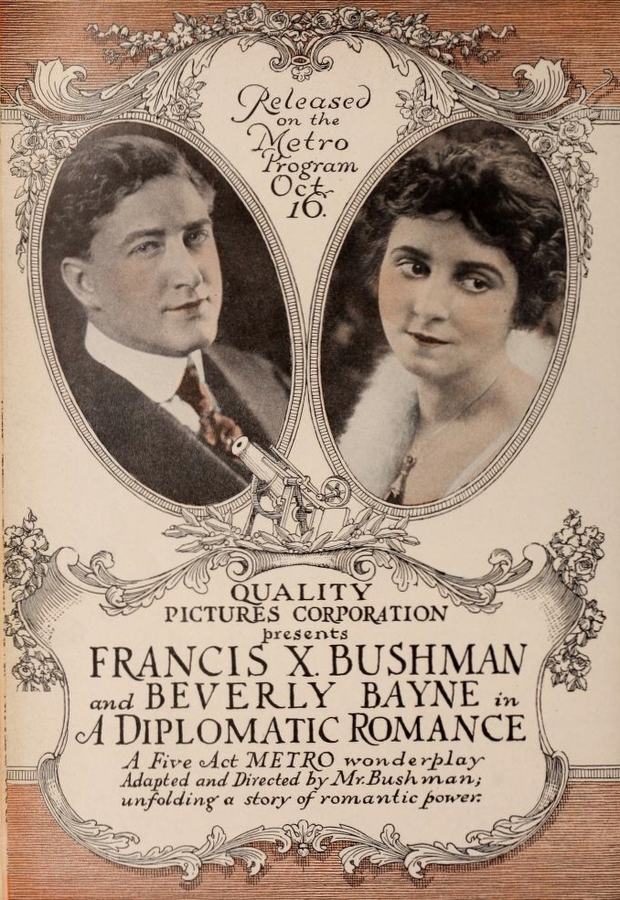
Dick Stansbury chooses a life of travel and pleasure rather than a more useful career. He returns from three years of foreign travel. His uncle, Major Blaine, interests him in a bold breach of ethics made by one of the foreign diplomats, Doctor Montell, but as yet nothing has been proved against the doctor, as he knows all the men in the Secret Service in Washington. Dick met him abroad, and Major Blaine persuades him to undertake the task of Doctor Montell's unmasking. Beverly Ryerson has a friend, an eccentric young authoress, Helen Wardlow, who is disgusted because, she says, there is no more originality in life. Beverly assures her that such is not the case. Dick, Beverly, Doctor Montell, Helen, Mrs. Ryerson, Beverly's step-mother, and her nephew, Lyna Hardi, who is loaning her money to pay her bridge debts, and who in return demands that she aid his cause with Beverly, are all at the Diplomats' Ball. Dick and Dr. Montell interest the girls and they induce Mrs. Ryerson to invite the men to a party at her country-house. Dick seizes the opportunity to ensnare the doctor in a plot that will prove his deceptions against the government. Dick has invented a "machine gun," supposed to fire a bomb that will burst anywhere within several hundred feet of an airship, asphyxiating the pilot and passengers with poisonous gas. He brings the model of the gun with him to the house-party, and takes care to talk about his invention where Montell can overhear him. He is soon approached by Montell with a proposition to deceive his own government, and sell the model to a foreign nation. Dick asks for time to consider the offer. Montell is determined to have the invention at once, and Hardi attempts to steal it for him, but is prevented by a Secret Service man. His reason for this move is that in trying to discredit big rival he has told Beverly that Dick is a traitor to his country. He has arranged for Beverly to overhear Dr. Montell and Dick talking about the invention. Though Dick has so far refused to sell, she fears he may succumb to the doctor's inducements, and to save him Beverly surreptitiously takes the model to her own room, though it is soon returned to Dick by one of his detectives. Montell and two accomplices then try to steal the model. Dick has been warned of their approach. He extends a wire from one of the house-lights to the model, and gets the janitor to operate a magneto at a signal. When the three malefactors step on a wet rug with the machine, they are held fast by the sudden shock of the electricity and caught by Dick. The ignominious recall of Dr. Montell by his own country is inevitable. Dick spares Hardi, since he has plotted against him only as a rival, not against him as a representative of the foreign government. In order to clear Beverly's mind of any possible doubt as to his loyalty to the nation, Dick next day asks her to accompany him to a junk dealer, to whom he offers his "wonderful invention." The junk-dealer finally consents to give him twenty-five cents for it. Out of sentiment, however, Beverly buys it back for $25. A happy denouement follows, and Helen, having found ample material for a plot, types busily away on her new story.
Decades after its release, In the Diplomatic Service remains a vital piece of the cinematic puzzle. Its influence can be seen in countless modern works, solidifying Francis X. Bushman's status as a master of the craft in United States and beyond.