
DbcultAccessing Vault...
Director's Spotlight
Senior Film Conservator
Director's Spotlight: United States
A Deep Dive into the 1934 Vision of Frank R. Strayer
Witnessing the stylistic transformation of Drama through La cruz y la espada reveals the provocative questions that Frank R. Strayer poses to the United States audience. Exploring the nuances of the human condition with Drama flair, it showcases the power of Drama as a tool for social commentary.
In La cruz y la espada, Frank R. Strayer pushes the boundaries of conventional narrative. The film's unique approach to its subject matter has sparked endless debates and interpretations among cinephiles and critics alike.
In this work, Frank R. Strayer explores the intersection of Drama and United States cultural identity. The meticulous attention to detail suggests a deep-seated commitment to pushing the boundaries of the medium, ensuring that La cruz y la espada remains a relevant topic of study for Drama enthusiasts.
| Cinematography | Static |
| Soundtrack | Orchestral |
| Editing | Invisible |
| Art Direction | Kitsch |
Visualizing the convergence of Frank R. Strayer's style and the core Drama narrative.
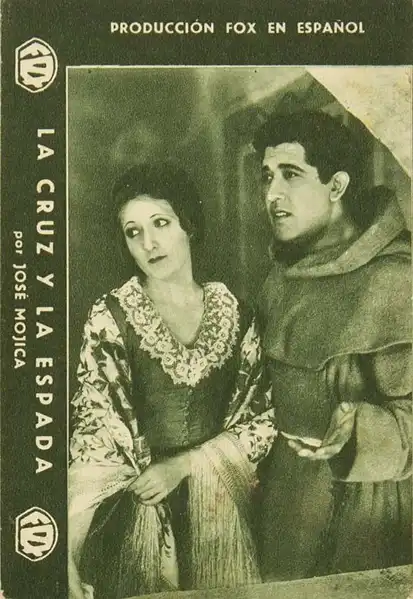
In California, in the late eighteenth century, José Antonio Romero lives in a village near one of Junípero Serra's Franciscan missions. When gold is discovered, José gets a group of men together to form a prospecting expedition. José goes to talk to his good friend, Brother Francisco, and tells him that he wants to find gold so that he can give a good life to his beloved, Carmela. Meanwhile, Carmela tells her aunt that she is not sure if she loves José. Bandits, led by El Mestizo, arrive at the mission and kidnap Carmela. Brother Francisco pursues then rescues her, and realizes that she is his friend José's beloved. At the chapel, Carmela is surprised to learn that her rescuer is Brother Francisco, and she asks why he gave up the world for a religious vocation. He tells her that it was because of his sorrow over a woman. Jaime arrives from the mining camp and tells Francisco that Esteban has been stabbed. Francisco volunteers to go to render medical aid and, on his way back from the camp, shelters from a storm in a cave where he discovers gold. Francisco then battles with temptation. His evil conscience tells him to take the beautiful Carmela and the gold. Francisco imagines that he goes to Carmela and tells her that he has burned his novitiate's clothing. However, Francisco overcomes these temptations and later writes to José telling him of the gold's location. In a cantina back at the village, a drunken local tells José that Carmela and Francisco have been seen flirting. José madly confronts Francisco, who denies all charges of infamy. After José attacks his old friend with a knife, Francisco tells him that Carmela is completely pure and José begs for the brother's forgiveness. Carmela arrives and Francisco says that José has asked him to sing at their wedding. At the ceremony, Francisco joyously sings their wedding song.
Decades after its release, La cruz y la espada remains a vital piece of the cinematic puzzle. Its influence can be seen in countless modern works, solidifying Frank R. Strayer's status as a master of the craft in United States and beyond.