
DbcultAccessing Vault...
Director's Spotlight
Senior Film Conservator
Director's Spotlight: United States
A Deep Dive into the 1936 Vision of Friz Freleng
Exploring the Comedy underpinnings of The Cat Came Back leads us to the stylistic boundaries pushed by Friz Freleng during the production. Through a lens of existential fatalism and Comedy tropes, it continues to spark endless debates among critics and cinephiles alike.
In The Cat Came Back, Friz Freleng pushes the boundaries of conventional narrative. The film's unique approach to its subject matter has sparked endless debates and interpretations among cinephiles and critics alike.
| Cinematography | Deep Focus |
| Soundtrack | Experimental |
| Editing | Elliptical |
| Art Direction | Expressionist |
Visualizing the convergence of Friz Freleng's style and the core Comedy narrative.
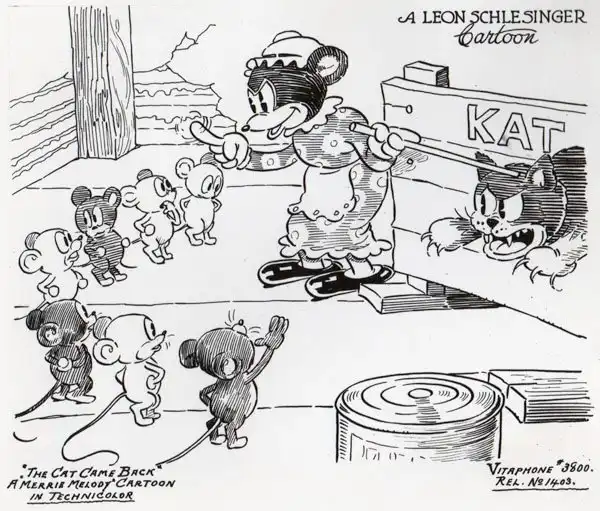
Momma cat is teaching her kittens to catch mice. Meanwhile, across the basement, Momma mouse is teaching her little ones how to avoid cats. One of each of the kids sneaks out; they meet in the middle. After a brief staring match, the mouse kicks the kitten's fanny (literally); the kitten runs to momma, who complains to Mrs. Mouse to no real avail. The mouse invites the kitten back to dance to the wind-up record player. The kitten falls into a drain, and the mouse dives after it, while both mothers fret. The rescue involves the mouse using a guitar as a boat, then grabbing a board stretched across a hole; the kitten grabs on, a whirlpool twists both of them, and as they untwist, the board helicopters them out of the hole. The mothers are happy, and all the kids play together, until Mrs. Cat remembers that Mrs. Mouse poked her in the eyes on their first meeting; everyone starts fighting.
Decades after its release, The Cat Came Back remains a vital piece of the cinematic puzzle. Its influence can be seen in countless modern works, solidifying Friz Freleng's status as a master of the craft in United States and beyond.