
DbcultAccessing Vault...
Director's Spotlight
Senior Film Conservator
Director's Spotlight: United States
A Deep Dive into the 1937 Vision of Friz Freleng
Witnessing the stylistic transformation of Family through The Lyin' Mouse reveals the provocative questions that Friz Freleng poses to the United States audience. Exploring the nuances of the human condition with Family flair, it showcases the power of Family as a tool for social commentary.
In The Lyin' Mouse, Friz Freleng pushes the boundaries of conventional narrative. The film's unique approach to its subject matter has sparked endless debates and interpretations among cinephiles and critics alike.
While deeply rooted in United States, The Lyin' Mouse has achieved a global reach, influencing directors from various backgrounds. Its ability to translate Family tropes into a universal cinematic language is why it remains a cult staple decades after its 1937 release.
| Cinematography | High-Contrast |
| Soundtrack | Minimalist |
| Editing | Disjunctive |
| Art Direction | Baroque |
Visualizing the convergence of Friz Freleng's style and the core Family narrative.
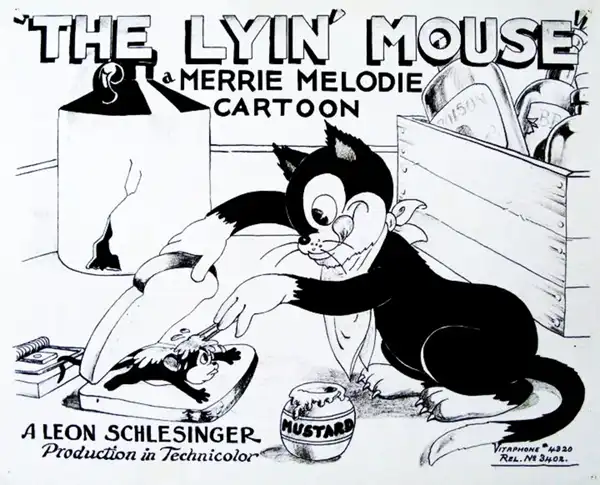
A mouse is trying to free himself from a trap when a cat arrives. The mouse, desperate, asks if the cat has heard the story of the lion and the mouse. We see the lion, scaring all the animals; the mouse has a horn that imitates the lion's roar, and has some fun with it until the lion catches him. The mouse pleads for his life, and the lion, distracted by a bigger catch, agrees. The bigger catch is a trap set by the Frank Cluck expedition; the lion avoids the first trap, but falls for the second, and find himself in a circus lion-taming act (where he put his head inside the tamer's mouth). The mouse happens by, and chews a lion-shaped hole in the lion's wooden cart/cage, setting him free. Back to the cat: moved by this story, he releases the mouse; just before entering his hole, the mouse has one last word for the cat: "Sucker!"
Decades after its release, The Lyin' Mouse remains a vital piece of the cinematic puzzle. Its influence can be seen in countless modern works, solidifying Friz Freleng's status as a master of the craft in United States and beyond.