
DbcultAccessing Vault...
Director's Spotlight
Senior Film Conservator
Director's Spotlight: United States
A Deep Dive into the 1918 Vision of George Abbott
Peeling back the layers of George Abbott's The Impostor exposes the collaborative alchemy between George Abbott and the 1918 creative team. Anchored by a narrative that is both personal and universal, it reinforces the idea that cinema is a medium of infinite possibilities.
In The Impostor, George Abbott pushes the boundaries of conventional narrative. The film's unique approach to its subject matter has sparked endless debates and interpretations among cinephiles and critics alike.
To fully appreciate The Impostor, one must consider the cinematic climate of 1918. During this period, United States was undergoing significant artistic shifts, and George Abbott was at the forefront of this cult movement, often challenging established norms.
| Cinematography | High-Contrast |
| Soundtrack | Minimalist |
| Editing | Disjunctive |
| Art Direction | Baroque |
Visualizing the convergence of George Abbott's style and the core cult narrative.
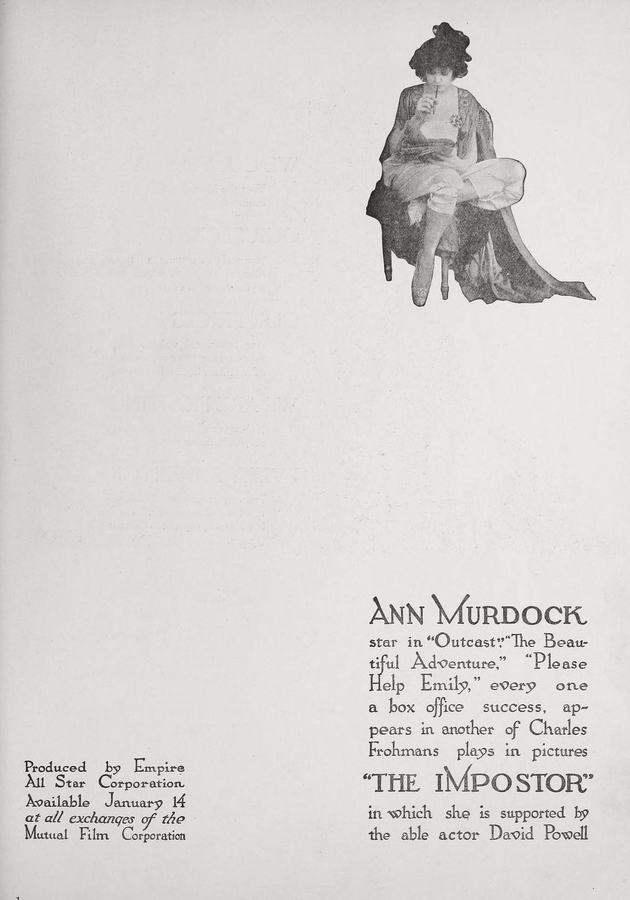
Mary Fenton, the star singer in her small town church choir, is assured by a phony impresario that with six months of voice lessons at his New York school, she will become famous. When the hopeful young girl arrives in New York, she finds the school closed, and is soon robbed of all her money. Sitting on a park bench, broke and friendless, she attracts the attention of Charles Owen, who lures her to his apartment with promises of money and protection. When his wife's friend drops by the apartment, Charles introduces Mary as his wealthy sister-in-law, and soon she is invited to visit the country home of his friends, the Walfords. After Owen's wife returns, Mary is forced to confess everything to the Walfords, but young Blake Walford, who has fallen in love with her, forgives her and proposes.
Decades after its release, The Impostor remains a vital piece of the cinematic puzzle. Its influence can be seen in countless modern works, solidifying George Abbott's status as a master of the craft in United States and beyond.