
DbcultAccessing Vault...
Director's Spotlight
Senior Film Conservator
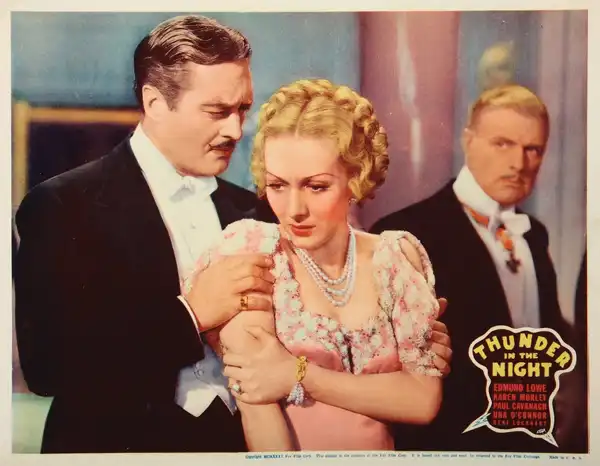
Director's Spotlight: United States
A Deep Dive into the 1935 Vision of George Archainbaud
To understand the modern evolution of United States film, one must first look at Thunder in the Night and the collaborative alchemy between George Archainbaud and the 1935 creative team. Subverting the expectations of the typical 1935 audience, it remains a vital reference point for anyone studying the evolution of George Archainbaud.
In Thunder in the Night, George Archainbaud pushes the boundaries of conventional narrative. The film's unique approach to its subject matter has sparked endless debates and interpretations among cinephiles and critics alike.
While deeply rooted in United States, Thunder in the Night has achieved a global reach, influencing directors from various backgrounds. Its ability to translate Mystery tropes into a universal cinematic language is why it remains a cult staple decades after its 1935 release.
| Cinematography | High-Contrast |
| Soundtrack | Experimental |
| Editing | Elliptical |
| Art Direction | Expressionist |
Visualizing the convergence of George Archainbaud's style and the core Mystery narrative.
On a windy evening in Budapest, police Captain Karl Torok meets with his superior, the prefect of police, who has just lost the position of president of the cabinet to Torok's friend since childhood, Count Peter Alvinczy. As thunder and lightning begin, the countess Madalaine's first husband, Paul Szegedy, who everyone thought had committed suicide, calls her and threatens to create a scandal that will ruin Peter's career unless she comes to his room at the Hotel Orient. After she agrees, Lisa, her maid, tells Peter about Szegedy's threat. At the hotel, as Szegedy packs to leave, his mistress and vaudeville partner, Katherine Szabo, pleads with him to stay. Professor Omega, a self-proclaimed mystic with whom Katherine toured before she met Szegedy, overhears their conversation and then warns Szegedy of disaster evidenced in a fearful vision of thunder in the night. Katherine goes to the police station across the street from the hotel and asks that they stop Szegedy from leaving her. An automobile crash interrupts her pleas, and after Torok and Gabor, his bumbling lieutenant, go outside to investigate, a porter from the hotel tells them that Szegedy has been murdered. Torok determines that Szegedy was shot in the heart. Julie, the maid, says that she saw a woman come to Szegedy's room twice, and Professor Omega says that he heard Szegedy quarrel with a woman on the staircase. Torok finds a newspaper with an article torn out and some expensive writing paper crumbled up. After he learns that the missing article was about the rumor that Peter was going to become the president of the cabinet, Torok questions the taxi driver involved in the crash and learns that he swerved to avoid hitting a woman who came running from the hotel wearing a black raincoat and black silk stockings. At a ball that night in honor of Peter's triumph, Gabor discovers the raincoat. Although Madalaine denies wearing it that night, after the the prefect reveals that the dead man was Madalaine's first husband, Torok searches her room and finds envelopes matching the paper found in Szegedy's room and muddy shoes and stockings. The prefect then arrests Madalaine. At Torok's request, he interrogates her in Szegedy's room. Madalaine admits that she did come to the room earlier that night but denies killing Szegedy, saying that she only gave him 25,000 pengars in an envelope to keep him quiet. To protect his wife, Peter then confesses that he killed Szegedy. After Torok proves that the professor had been in Szegedy's room, the professor admits that he stole the money, but says that Szegedy was already dead when he entered the room. Torok then deduces the solution to the murder and demonstrates that Katherine, left alone in the police station while he and Gabor investigated the crash, saw Szegedy look out from his window and, being a sharpshooter, killed him with a gun Gabor left in the office. Katherine then shoots herself, and the prefect, at Torok's suggestion, apologizes and agrees not to make public the fact that Szegedy was Madalaine's first husband.
Decades after its release, Thunder in the Night remains a vital piece of the cinematic puzzle. Its influence can be seen in countless modern works, solidifying George Archainbaud's status as a master of the craft in United States and beyond.