
DbcultAccessing Vault...
Director's Spotlight
Senior Film Conservator
Director's Spotlight: United States
A Deep Dive into the 1920 Vision of Hank Mann
The artistic breakthrough represented by Broken Bubbles in 1920 highlights the philosophical inquiries that Hank Mann embeds within the narrative. Framed by the hauntingly beautiful landscapes of the production, it leaves an indelible mark on the soul of the viewer.
In Broken Bubbles, Hank Mann pushes the boundaries of conventional narrative. The film's unique approach to its subject matter has sparked endless debates and interpretations among cinephiles and critics alike.
| Cinematography | Static |
| Soundtrack | Orchestral |
| Editing | Invisible |
| Art Direction | Kitsch |
Visualizing the convergence of Hank Mann's style and the core Comedy narrative.
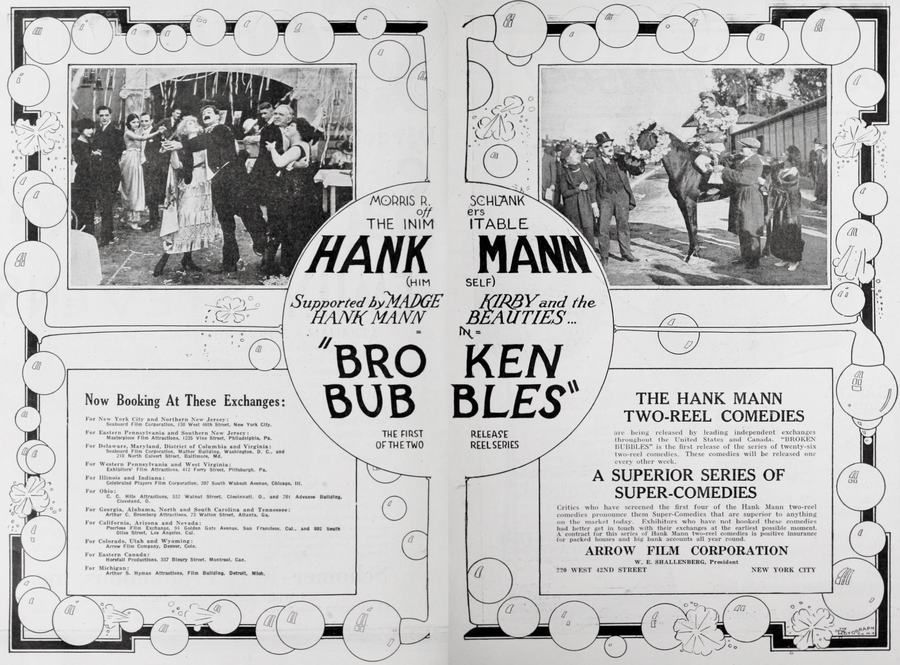
A poor chap, with only fifty cents, hesitates whether to buy a meal with it or visit a fortune teller. He chooses the latter, and gazing into a crystal globe, he is told to follow the horses. He is then shown working around a racing stable, and, of course, rides the heroine's horse to victory. That night they decide to celebrate in a cabaret, where several amusing complications ensue. All this is revealed in the crystal ball and, waking up, Hank finds himself in the fortune teller's booth. Going out, he gazes longingly at the sign advertising meals for a half a dollar.
Decades after its release, Broken Bubbles remains a vital piece of the cinematic puzzle. Its influence can be seen in countless modern works, solidifying Hank Mann's status as a master of the craft in United States and beyond.