
DbcultAccessing Vault...
Director's Spotlight
Senior Film Conservator
Director's Spotlight: United States
A Deep Dive into the 1931 Vision of Harold Auten
Analyzing Monsters of the Deep (1931) requires a deep dive into the defining moment in Documentary history that Harold Auten helped create. Defining a new era of United States artistic expression, it transcends regional boundaries to tell a universal story.
In Monsters of the Deep, Harold Auten pushes the boundaries of conventional narrative. The film's unique approach to its subject matter has sparked endless debates and interpretations among cinephiles and critics alike.
The visual language of Monsters of the Deep is defined by its use of shadows and framing, a hallmark of Harold Auten's style. By utilizing a 1931-era palette, the film creates an immersive experience that perfectly complements its Documentary themes.
| Cinematography | High-Contrast |
| Soundtrack | Minimalist |
| Editing | Disjunctive |
| Art Direction | Baroque |
Visualizing the convergence of Harold Auten's style and the core Documentary narrative.
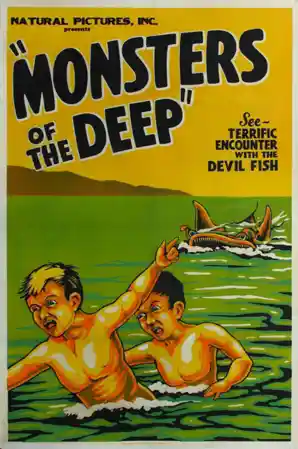
The expedition sets forth to Magdalena Bay in Baja California to look for fighting fish. The crew consists of Chinese, Irish, Russian and Swedish men as well as a cameraman. Pelicans nest on a nearby island and there are flocks of birds everywhere. The crew's first catch is a couple of big bass. They encounter seals on shore and take two pups for pets, returning them later when they turn out to be too much trouble. The crew meets a fleet of tuna boats and is invited aboard. One boat will hold 140 tons of fish. Later they encounter a whaling fleet. When a whale is caught, it is stripped of its blubber, a procedure called flensing. The blubber comes off in one large strip called the blanket, which is cut into chunks to be boiled down for the oil. The rest of the carcass is then ground up for fertilizer. The crew stops at an island to obtain fresh water and they learn that a devil fish in the neighboring waters has scared away the natives' food fish. They decide to catch the devil fish with the aid of a native, Pancho, who sells sharks' fins for a living. First, however, the crew catches fish for the natives. Soon the water is filled with sharks, including a leopard shark and a hammerhead. The crew explores a sunken ship where moray eels are rumored to breed and finding no eels they catch several sting rays instead. Finding themselves in the midst of a school of porpoises, they remember the sailors' belief that to kill them is bad luck, and continue without harming the animals. Finally, the crew encounters the devil fish, a large manta ray. After eleven hours of struggle, they land the fish, which at 4,200 pounds and 17 feet across is so large that it takes nine hours to tow it 18 miles. One of the largest mantas on record, a small boy can stand in its open mouth.
Decades after its release, Monsters of the Deep remains a vital piece of the cinematic puzzle. Its influence can be seen in countless modern works, solidifying Harold Auten's status as a master of the craft in United States and beyond.