
DbcultAccessing Vault...
Director's Spotlight
Senior Film Conservator
Director's Spotlight: United States
A Deep Dive into the 1922 Vision of Harold Beaudine
When we examine the cinematic landscape of United States, Mile-a-Minute Mary emerges as a landmark work of the enduring legacy of Harold Beaudine's artistic contribution to the genre. Through a lens of existential fatalism and Short tropes, it captures a specific kind of cinematic magic that is rarely replicated.
In Mile-a-Minute Mary, Harold Beaudine pushes the boundaries of conventional narrative. The film's unique approach to its subject matter has sparked endless debates and interpretations among cinephiles and critics alike.
While deeply rooted in United States, Mile-a-Minute Mary has achieved a global reach, influencing directors from various backgrounds. Its ability to translate Short tropes into a universal cinematic language is why it remains a cult staple decades after its 1922 release.
| Cinematography | High-Contrast |
| Soundtrack | Experimental |
| Editing | Invisible |
| Art Direction | Kitsch |
Visualizing the convergence of Harold Beaudine's style and the core Short narrative.
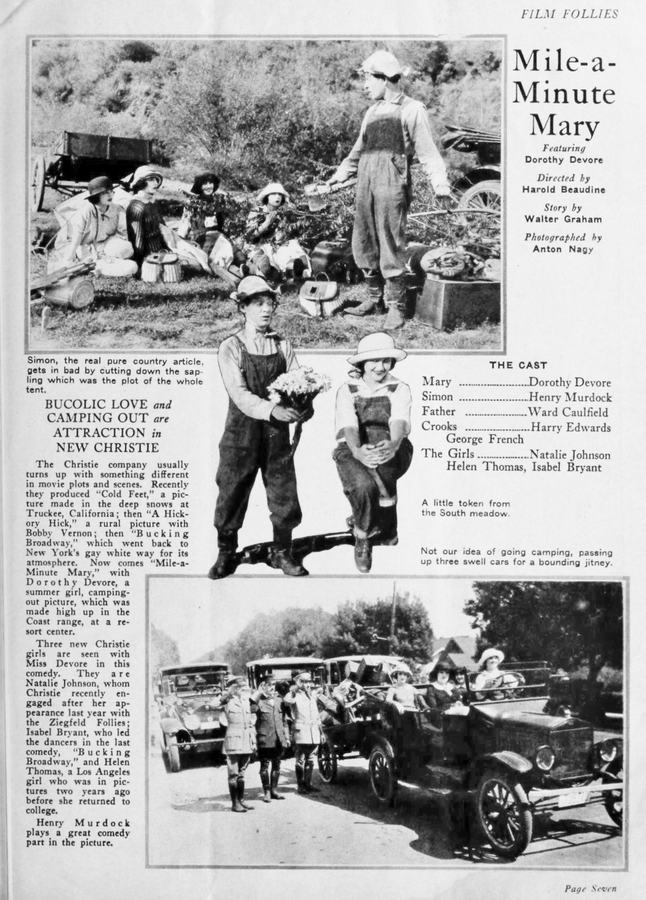
Mary's father has given her a flivver. Mary invites three chums to accompany her upon a camping trip, but not until after she has mastered the knowledge of how to control the Henry. Her lessons offer reason for part of the fun, then the camping episode involves the admiration of a country boy for the girls in general. There is a little plot concerning an option on an oil gusher, which through Mary's carelessness father almost loses, but she saves the day by getting him to the lawyer's office in the nick of time to take it up. It is up to Mary to race with a high powered motor, but by clever manipulation she wins. Fun races through with the cars and is at high speed when the country boy attempts to follow his ideal and present her with a bouquet. As a reward for her daring, father presents Mary with a regular car in the end.
Decades after its release, Mile-a-Minute Mary remains a vital piece of the cinematic puzzle. Its influence can be seen in countless modern works, solidifying Harold Beaudine's status as a master of the craft in United States and beyond.