
DbcultAccessing Vault...
Director's Spotlight
Senior Film Conservator
Director's Spotlight: United States
A Deep Dive into the 1923 Vision of Harry A. Pollard
Deciphering the layers of Something for Nothing (1923) reveals a monumental shift in Short filmmaking spearheaded by Harry A. Pollard. With its avant-garde structure and atmospheric tension, offering layers of thematic complexity that demand repeated viewing.
In Something for Nothing, Harry A. Pollard pushes the boundaries of conventional narrative. The film's unique approach to its subject matter has sparked endless debates and interpretations among cinephiles and critics alike.
While deeply rooted in United States, Something for Nothing has achieved a global reach, influencing directors from various backgrounds. Its ability to translate Short tropes into a universal cinematic language is why it remains a cult staple decades after its 1923 release.
| Cinematography | Deep Focus |
| Soundtrack | Experimental |
| Editing | Elliptical |
| Art Direction | Expressionist |
Visualizing the convergence of Harry A. Pollard's style and the core Short narrative.
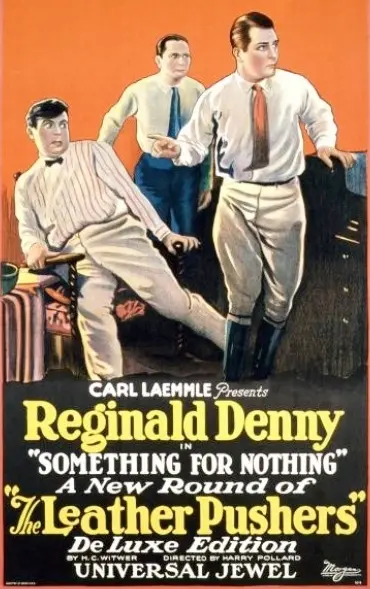
Kid Roberts, seeking the championship crown, gets lost in the wilds of Mexico with Joe Murphy, his manager and Ptomaine Tommy, his sparring partner. In their attempt to locate Tia Juana where the big fight is to be held, they come upon what seems to be the beautiful estate of a wealthy man. On entering, however, they find that it is the retreat of a famous bandit, who, on learning that Kid Roberts is the head of the party, decides to hold them for ransom instead of killing them. After making this startling announcement, the bandit points out two men, loitering near by, and warns his new guests that if he catches them talking to them, he will have them executed forthwith. Consequently our heroes repulse the several advances made by the gentlemen during their stay. Later the bandit sends some of his men to bring the champion heavyweight to his retreat so that he can witness a fight between him and Kid Roberts. Bob Young, the champ, arrives tied to his manager and the fight is arranged. The bandit announces that the loser will be shot, before he can get up from the floor. The result of this announcement is a corking good fight. At the end the bandit has become so excited that he nearly has a fit. Several of his attendants rush to him and carry him away. It is then that Kid Roberts learns that the bandit is nothing but a mentally deranged man who is being taken care of by his relatives. The gentlemen to whom they were forbidden to speak on pain of death were the men in charge of the sanatorium. He is certainly sore that he put up such a good fight for nothing.
Decades after its release, Something for Nothing remains a vital piece of the cinematic puzzle. Its influence can be seen in countless modern works, solidifying Harry A. Pollard's status as a master of the craft in United States and beyond.