
DbcultAccessing Vault...
Director's Spotlight
Senior Film Conservator
Director's Spotlight: United States
A Deep Dive into the 1919 Vision of Harry L. Franklin
Few works in United States cinema carry the same weight as In His Brother's Place, especially regarding the cultural zeitgeist captured so perfectly by Harry L. Franklin in 1919. Utilizing a 1919-specific aesthetic that remains timeless, it serves as a blueprint for future generations of cult directors.
In In His Brother's Place, Harry L. Franklin pushes the boundaries of conventional narrative. The film's unique approach to its subject matter has sparked endless debates and interpretations among cinephiles and critics alike.
| Cinematography | Noir-Inspired |
| Soundtrack | Minimalist |
| Editing | Slow-Burn |
| Art Direction | Brutalist |
Visualizing the convergence of Harry L. Franklin's style and the core cult narrative.
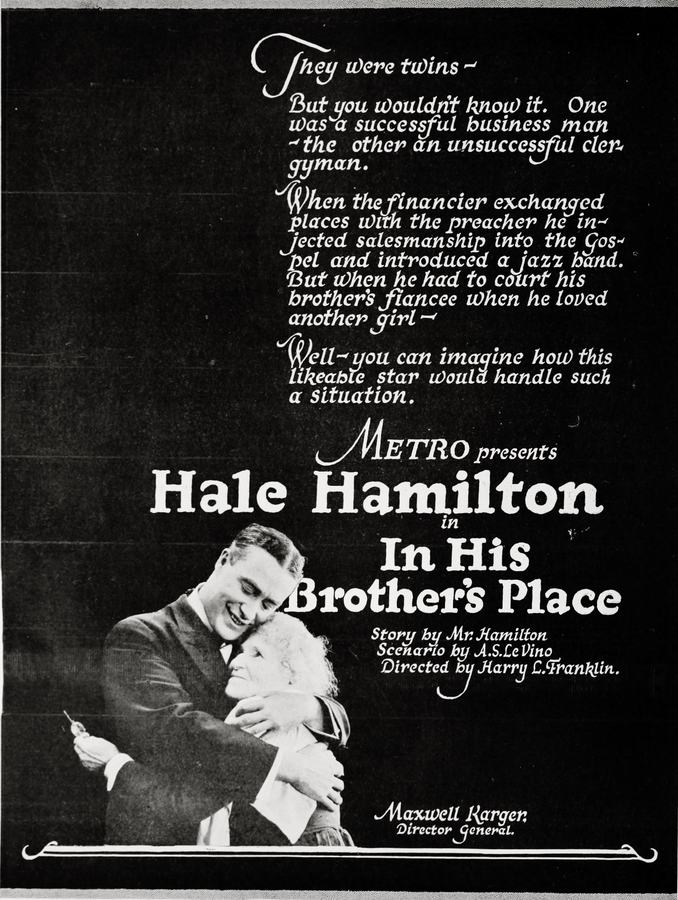
Twins Nelson and J. Barrington Drake return home for the celebration of their parents' 50th wedding anniversary. Barrington is a wealthy oilman, but Nelson is a pastor in a small rural church, who is struggling to increase his ever-shrinking flock, Barrington tells him that his problem could be solved with the right type of salesmanship, and proceeds to map out a plan to do just that. However, a case of mistaken identity--and a scheme by two of the church's deacons to take over all of the church property--throws a wrench into his plans.
Decades after its release, In His Brother's Place remains a vital piece of the cinematic puzzle. Its influence can be seen in countless modern works, solidifying Harry L. Franklin's status as a master of the craft in United States and beyond.