
DbcultAccessing Vault...
Director's Spotlight
Senior Film Conservator
Director's Spotlight: United States
A Deep Dive into the 1936 Vision of Hugh Harman
Peeling back the layers of Hugh Harman's Bottles exposes the collaborative alchemy between Hugh Harman and the 1936 creative team. Anchored by a narrative that is both personal and universal, it reinforces the idea that cinema is a medium of infinite possibilities.
In Bottles, Hugh Harman pushes the boundaries of conventional narrative. The film's unique approach to its subject matter has sparked endless debates and interpretations among cinephiles and critics alike.
| Cinematography | Deep Focus |
| Soundtrack | Diegetic |
| Editing | Rhythmic |
| Art Direction | Naturalist |
Visualizing the convergence of Hugh Harman's style and the core Animation narrative.
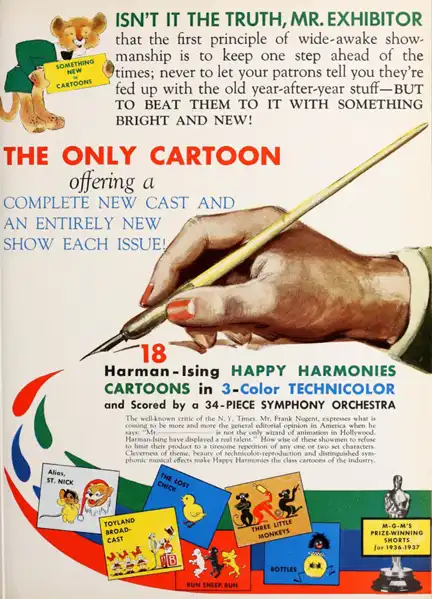
A dark and stormy night in a drugstore. The druggist mixes a potion and falls asleep. The skull-and-crossbones on the bottle comes to life and drips the potion on the druggist, shrinking him. The baby bottles start crying (in three-part harmony). The druggist lights a lantern, then plays a perfume atomizer like bagpipes, bringing a bottle of Scotch Whiskey to life. Other bottles that come alive include smelling salts, bath salts, Listerine, perfume, india ink (doing a snake charmer bit with some Cobra toothpaste). A Dutch boy and girl go figure skating on a mirror, with help from some talcum-powder snow. The druggist wraps a pipe around himself and plays it as a tuba. The skull and crossbones hatch a nefarious scheme, helped by the witch hazel and spirits of ammonia ghosts. He gets sent through distilling apparatus and is otherwise mangled and then he wakes up.
Decades after its release, Bottles remains a vital piece of the cinematic puzzle. Its influence can be seen in countless modern works, solidifying Hugh Harman's status as a master of the craft in United States and beyond.