
DbcultAccessing Vault...
Director's Spotlight
Senior Film Conservator
Director's Spotlight: United States
A Deep Dive into the 1936 Vision of Jack King
As we revisit the 1936 masterpiece Porky's Moving Day, we are struck by the atmospheric immersion that Jack King achieves throughout Porky's Moving Day. Exploring the nuances of the human condition with Family flair, it solidifies Jack King's reputation as a master of the craft.
In Porky's Moving Day, Jack King pushes the boundaries of conventional narrative. The film's unique approach to its subject matter has sparked endless debates and interpretations among cinephiles and critics alike.
While deeply rooted in United States, Porky's Moving Day has achieved a global reach, influencing directors from various backgrounds. Its ability to translate Family tropes into a universal cinematic language is why it remains a cult staple decades after its 1936 release.
| Cinematography | Static |
| Soundtrack | Experimental |
| Editing | Elliptical |
| Art Direction | Expressionist |
Visualizing the convergence of Jack King's style and the core Family narrative.
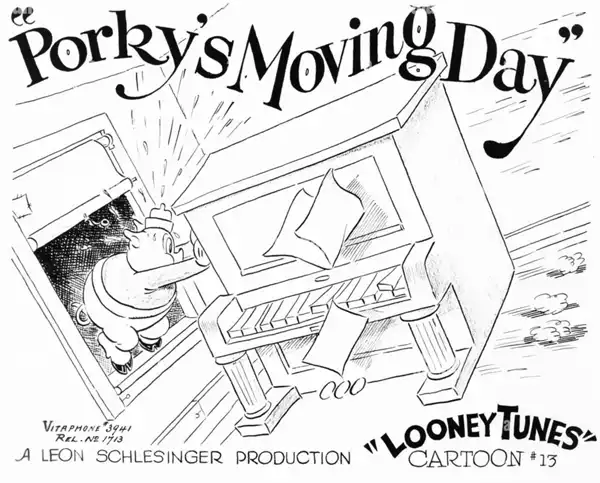
A woman's house, on the side of the cliff, is about to fall into the sea, due to waves washing away the cliff. In a panic, she call's Porky's moving company. Porky's assistant, a former boxer, starts swinging when he hears a bell until hit on the head, when he stops and says, "Okay, boss." Porky's van is pulled by an ostrich. They get to the house and have various adventures while moving the furniture, mostly because the entire house keeps tilting back and forth on the shaky ground. Finally, a big wave washes most of the house's contents into the van.
Decades after its release, Porky's Moving Day remains a vital piece of the cinematic puzzle. Its influence can be seen in countless modern works, solidifying Jack King's status as a master of the craft in United States and beyond.