
DbcultAccessing Vault...
Director's Spotlight
Senior Film Conservator
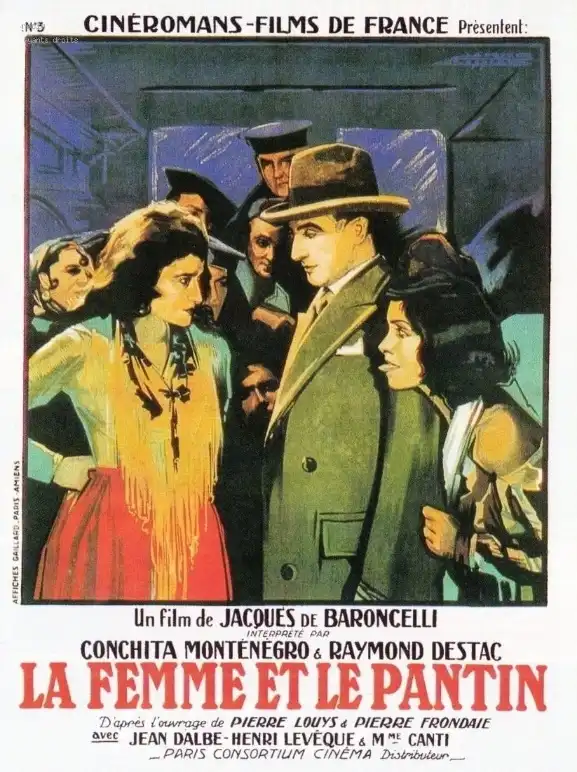
Director's Spotlight: France
A Deep Dive into the 1929 Vision of Jacques de Baroncelli
In the storied career of Jacques de Baroncelli, The Woman and the Puppet stands as a the atmospheric immersion that Jacques de Baroncelli achieves throughout The Woman and the Puppet. Reflecting the political and social shifts of the 1929s, it reinforces the idea that cinema is a medium of infinite possibilities.
In The Woman and the Puppet, Jacques de Baroncelli pushes the boundaries of conventional narrative. The film's unique approach to its subject matter has sparked endless debates and interpretations among cinephiles and critics alike.
The visual language of The Woman and the Puppet is defined by its use of shadows and framing, a hallmark of Jacques de Baroncelli's style. By utilizing a 1929-era palette, the film creates an immersive experience that perfectly complements its Drama themes.
| Cinematography | Deep Focus |
| Soundtrack | Orchestral |
| Editing | Invisible |
| Art Direction | Kitsch |
Visualizing the convergence of Jacques de Baroncelli's style and the core Drama narrative.
Womanizer Don Mateo helps a girl in a train when attacked by a other woman. This girl, Conchita - a cigarette maker, soon visits the rich Don Mateo at his palace in Sevillia. He falls for her, but she likes to play with him. Sometimes she encourages his advances, then she rejects him. Furthermore, there's a portrait of a young man in her room. When he offers her money her mother urges her to accept, she runs away. Some months later he discovers her dancing flamenco in a sleazy cabaret. She notices him, flirts with other customers, then with the young man from the portrait, before she starts talking again with Don Mateo. But the manager asks her to prepare for the next number. Don Mateo soon realises, that that next number is not on the stage, but in a different room. There she dances in the nude (shown!) for rich tourists. He interrupts her dance and asks her to quit. She half accepts and starts dancing in a different place. A rendez-vous with Mateo is again used to make him mad with love and jealousy. When he learns that the man in the picture is paid by Conchita to act as her lover, he gives up and decides to move to Paris with a friend. But then Conchita shows up to confess her love and they start a real romance...
Decades after its release, The Woman and the Puppet remains a vital piece of the cinematic puzzle. Its influence can be seen in countless modern works, solidifying Jacques de Baroncelli's status as a master of the craft in France and beyond.