
DbcultAccessing Vault...
Director's Spotlight
Senior Film Conservator
Director's Spotlight: United States
A Deep Dive into the 1915 Vision of James Durkin
In the storied career of James Durkin, The Mummy and the Humming Bird stands as a the provocative questions that James Durkin poses to the United States audience. Elevating the source material through James Durkin's unique vision, it persists as a haunting reminder of our own cinematic history.
In The Mummy and the Humming Bird, James Durkin pushes the boundaries of conventional narrative. The film's unique approach to its subject matter has sparked endless debates and interpretations among cinephiles and critics alike.
While deeply rooted in United States, The Mummy and the Humming Bird has achieved a global reach, influencing directors from various backgrounds. Its ability to translate cult tropes into a universal cinematic language is why it remains a cult staple decades after its 1915 release.
| Cinematography | Static |
| Soundtrack | Synth-Heavy |
| Editing | Disjunctive |
| Art Direction | Baroque |
Visualizing the convergence of James Durkin's style and the core cult narrative.
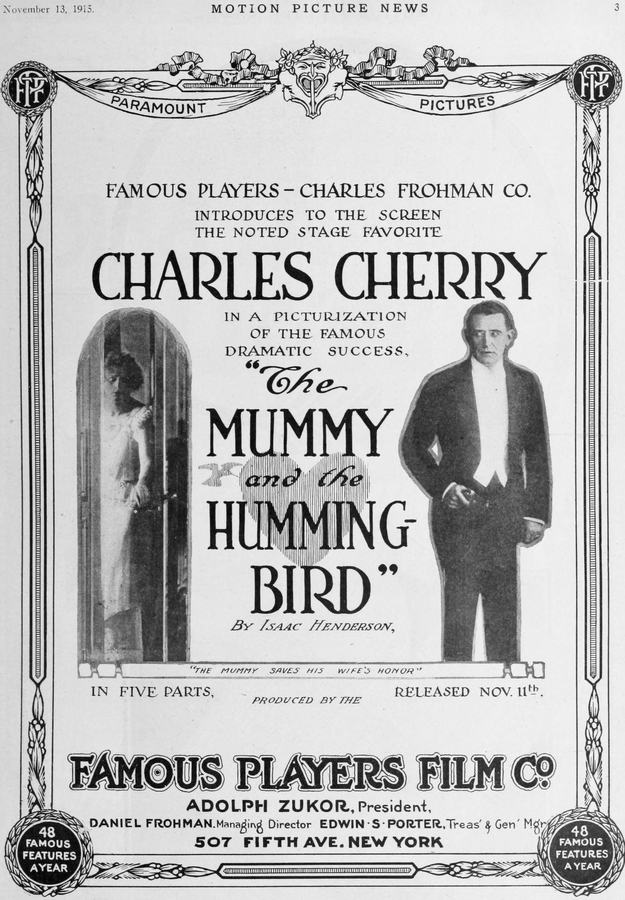
"The Mummy and the Humming-Bird" recounts the tragedy of a neglected wife who seeks amusement in the company of an unscrupulous Italian novelist whose only object in making love to her is the hope of eventually accomplishing her downfall. The reawakening of the unsuspecting husband, the revenge of which a former victim of the wily schemer wreaks, and the saving of the innocent woman are fraught with thrills and dramatic suspense in abundance. It is the sort of production which can not but impress those who view it. (Hearst's Sunday American, ((Atlanta, Ga.)) 7 November 1915)
Decades after its release, The Mummy and the Humming Bird remains a vital piece of the cinematic puzzle. Its influence can be seen in countless modern works, solidifying James Durkin's status as a master of the craft in United States and beyond.