
DbcultAccessing Vault...
Director's Spotlight
Senior Film Conservator
Director's Spotlight: United States
A Deep Dive into the 1919 Vision of John Francis Dillon
As we revisit the 1919 masterpiece Burglar by Proxy, we are struck by the atmospheric immersion that John Francis Dillon achieves throughout Burglar by Proxy. Exploring the nuances of the human condition with cult flair, it solidifies John Francis Dillon's reputation as a master of the craft.
In Burglar by Proxy, John Francis Dillon pushes the boundaries of conventional narrative. The film's unique approach to its subject matter has sparked endless debates and interpretations among cinephiles and critics alike.
While deeply rooted in United States, Burglar by Proxy has achieved a global reach, influencing directors from various backgrounds. Its ability to translate cult tropes into a universal cinematic language is why it remains a cult staple decades after its 1919 release.
| Cinematography | Handheld |
| Soundtrack | Minimalist |
| Editing | Slow-Burn |
| Art Direction | Brutalist |
Visualizing the convergence of John Francis Dillon's style and the core cult narrative.
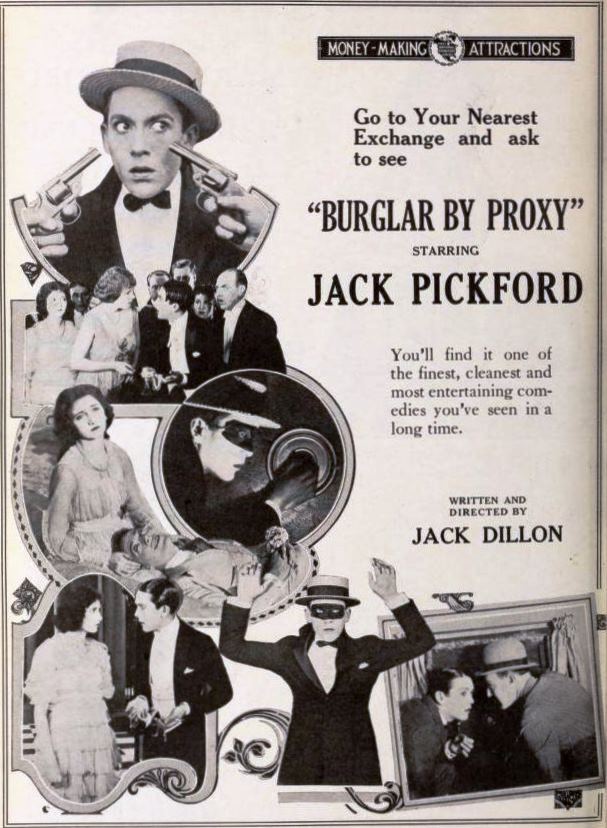
A terrible toothache causes Jack Robin to stop his automobile in front of the home of Dorothy Mason. Noticing a flat tire, Jack attaches his automatic pump and forgets about it as he listens enthralled to Dorothy's singing. When the sound of the burst tire brings Dorothy running out, Jack feigns injury so he can be nursed by her. After he leaves the house, and Dorothy's father discovers some important invention plans missing, Harlan Graves, Dorothy's suitor, suggests that Jack stole them. Jack, suspecting Graves, breaks into Graves' home to clear himself and meets a real burglar, "Spider" Kelly, who adopts Jack as his guide. They blow up a safe at a house party where Jack suspects the plans to be hidden. The papers are found, Graves is arrested and Spider, disappointed that Jack made such a mess in blowing the safe, goes off, leaving Dorothy and Jack happily alone.
Decades after its release, Burglar by Proxy remains a vital piece of the cinematic puzzle. Its influence can be seen in countless modern works, solidifying John Francis Dillon's status as a master of the craft in United States and beyond.