
DbcultAccessing Vault...
Film History
Senior Film Conservator
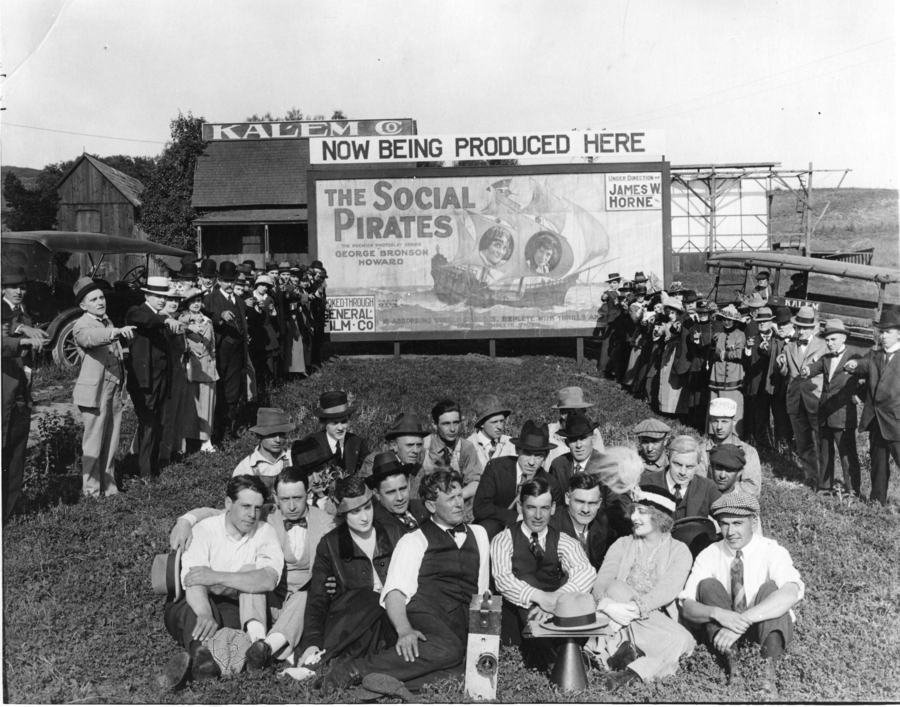
We are often told that the cult of the female vigilante began with the grit of the 1970s, born from the smoke of grindhouse theaters and the second-wave feminist movement. It is a tidy, convenient lie. If you want to find the real source of the transgressive woman, you have to look back to 1916, specifically to a series of shorts produced by the Kalem Company titled The Social Pirates. These films didn’t just feature women in lead roles; they featured women who had reached a breaking point with systemic male predation. They weren't waiting for a hero. They were the ones holding the keys, the guns, and the getaway cars.
The premise of The Social Pirates is a sharp, jagged piece of glass in the eye of early 20th-century social norms. Mary and Mona, two women tired of being taken advantage of by 'cads,' vow to stop these men from preying on the helpless. This isn't a domestic drama. It is a tactical operation. In an era where cinema usually relegated women to the role of the 'fallen girl'—much like the titular character in Kilmeny (1915) who drifts away with gypsies and loses her identity—Mary and Mona retained absolute agency. They operated in the shadows of the city, using the very tools of the 'social pirates' (the corrupt elite) against them. It was the first time we saw the blueprint for the modern cult anti-heroine: a woman who operates outside the law because the law is a rigged game.
To understand why The Social Pirates feels so modern, you have to contrast it with the standard 'woman in peril' tropes of the 1920s. Take The Unfortunate Marriage (1917), where an heiress is trapped by a dying father's request and a villainous husband. The conflict there is internal, a slow rot of Victorian morality. But by the time we get to 1922's Hurricane's Gal, the spirit of the social pirate had evolved into something even more aggressive. Dorothy Dalton’s Lola is a girl captain of a smuggling schooner. She doesn't just navigate the sea; she rules 'wild men.' When she is betrayed, she doesn't weep. She takes back what is hers by force.
This shift from victim to aggressor is the heartbeat of cult cinema. Lola in Hurricane's Gal represents a radical departure from the 'Woman's Honor' trope seen in films like A Woman's Honor (1916). In the latter, 'honor' is a fragile thing to be protected by male intervention. In the world of the smuggling schooner, honor is something you carve out with a knife. It’s a debatable opinion, perhaps, but I’d argue that 1916-1922 was a more progressive era for female characterization than the sanitized 1950s. These women were allowed to be messy, violent, and unapologetically ambitious before the Hays Code attempted to lobotomize the American screen.
"The Social Pirates didn't just break the rules; they suggested the rules were a fiction created by the powerful to keep the desperate in line."
One of the most recurring themes in these early cult-adjacent films is the utter failure of official institutions. If the police were competent, Mary and Mona wouldn't need to be pirates. We see this distrust of the badge echoed in the comedic shorts of the era, though through a lens of mockery rather than vengeance. Look at Brass Buttons (1920). The rookie policeman is a nuisance, a man 'putting his oar in where it doesn't belong.' He isn't a protector; he's a slapstick obstacle. This skepticism toward the 'arm of the law' is even more pronounced in The Burglar (1924), where a character is 'dragooned' into being a policeman against his will. The uniform is a costume, not a calling.
This cynicism creates a vacuum that the cult protagonist must fill. In Sherlock Brown (1922), William Brown wants to be a detective so badly he buys a tin badge for five dollars. It’s a joke, a farce about a man trying to play hero in a world of real secret government formulas and stolen explosives. But the subtext is clear: the professionals are nowhere to be found. When we watch The Masked Menace (1927), the terror of 'Still Face' isn't stopped by a local precinct. It requires Faith Newton (Jean Arthur) and a civilian ally to dismantle the threat. The cult of the individual—the idea that you alone are responsible for your survival—is baked into the nitrate itself.
Cult cinema lives in the fringes, and the silent era was surprisingly obsessed with the 'vice' that respectable society pretended didn't exist. In For a Woman's Fair Name (1916), the shadow over the domestic bliss of Vivien and Pierce isn't a ghost; it's Bolles, a 'dope fiend' secretary. This isn't a metaphorical addiction. It’s presented as a visceral, creeping threat to the home. The presence of the addict, the smuggler, and the jewel thief in these films serves as a reminder that the Gilded Age was rotting from the inside out.
We see this decay perfected in The Return of the Rat (1929). Pierre Boucheron, 'The Rat,' is a man of the Paris underworld. When forced to defend his honor against a rich, amoral wife, he doesn't seek legal recourse. He retreats to his 'old domain.' The underworld is portrayed not as a place of punishment, but as a sanctuary for those the 'upper' world has chewed up and spat out. This is a crucial distinction in cult history: the 'bad' place is often the only place where the protagonist can be honest. It is the same logic that drives the survivalism in Black Lightning (1924), where a war veteran and his dog Thunder flee to the mountains to escape the trauma of the firing line. The mountain, the underworld, the smuggling schooner—these are all liminal spaces where the social pirates of the world find their true selves.
While The Social Pirates dealt with direct action, other films of the era focused on the slow violence of class. Caleb Piper's Girl (1923) is a perfect example. A sea town, a mortgaged cottage, and an eviction threat based on 'unkind words.' This is the horror of the mundane. The villain isn't a masked menace; he's a neighbor with a grudge and a bank account. Cult cinema has always resonated with the 'unsuccessful suitor' or the 'discontented wife' (as seen in What's Your Reputation Worth?) because it acknowledges that the most terrifying monsters are often the ones holding your debt.
If the police are a joke and the elite are pirates, who tells the story? The Power of the Press (1928) gives us a cynical answer. Clem, the naive cub reporter, lands a scoop by essentially framing a woman named Jane for murder in his 'enthusiasm.' It is only when the victim confronts the creator of the narrative that the truth emerges. This is a shockingly modern take on media manipulation. It suggests that the 'social' part of social piracy is the ability to control the public's perception of guilt and innocence.
We see a different kind of narrative control in The White Lie (1918), where a portrait of a man's wife in another man's home leads to a total collapse of domestic trust. The 'image' is the evidence, regardless of the reality. This obsession with reputation and 'fair names' is what Mary and Mona were fighting against. They knew that for a woman in 1916, a 'white lie' or a bad scoop was a death sentence. Their response was to stop being the subject of the story and start being the ones who ended it. They were the original 'Trouble Makers,' a title literally used in the 1917 short The Trouble Maker, where the disruption of the status quo is the only path to resolution.
The tragedy of early cult cinema is how much of it was discarded as 'disposable' entertainment. We look at a film like The Frogs Who Wanted a King (1922) and see a simple animation about frogs asking God for a ruler, only to be punished for their inability to govern themselves. But isn't that the overarching theme of the era? Whether it's the frogs, the smugglers in Hurricane's Gal, or the vigilantes in The Social Pirates, the message is consistent: those in power are often more dangerous than the chaos they claim to prevent.
The 'Social Pirate' isn't just a character type; it's a structural critique. These films survived in the margins of history because they spoke to an audience that knew exactly what it felt like to have a 'mortgaged cottage' or a 'crippled hand' (as in the 1916 film of the same name). They were for the people who realized that the only way to beat a rigged system was to become a pirate of that system. It’s my firm belief that the current wave of 'elevated' social thrillers has nothing on the raw, unpolished anger of a 1916 Kalem short. We haven't gotten smarter; we've just gotten more polite. And if there's one thing the Social Pirates taught us, it's that politeness is the first tool of the oppressor.
When we watch The Return of the Rat today, we aren't just looking at a crime romance. We are looking at the DNA of every 'outlaw' film that followed. We are looking at the moment cinema decided that the 'Rat' in the underworld was more honorable than the 'Zelie' in the mansion. That is the true beginning of cult cinema. Not in the 70s, not in the midnight movie houses of the 80s, but in the flickering, high-contrast world where Mary and Mona first decided that they had seen enough.