
DbcultAccessing Vault...
Director's Spotlight
Senior Film Conservator
Director's Spotlight: United States
A Deep Dive into the 1935 Vision of John Reinhardt
When we examine the cinematic landscape of United States, Tango Bar emerges as a landmark work of the enduring legacy of John Reinhardt's artistic contribution to the genre. Through a lens of existential fatalism and Drama tropes, it captures a specific kind of cinematic magic that is rarely replicated.
In Tango Bar, John Reinhardt pushes the boundaries of conventional narrative. The film's unique approach to its subject matter has sparked endless debates and interpretations among cinephiles and critics alike.
The visual language of Tango Bar is defined by its use of shadows and framing, a hallmark of John Reinhardt's style. By utilizing a 1935-era palette, the film creates an immersive experience that perfectly complements its Drama themes.
| Cinematography | Noir-Inspired |
| Soundtrack | Synth-Heavy |
| Editing | Rhythmic |
| Art Direction | Naturalist |
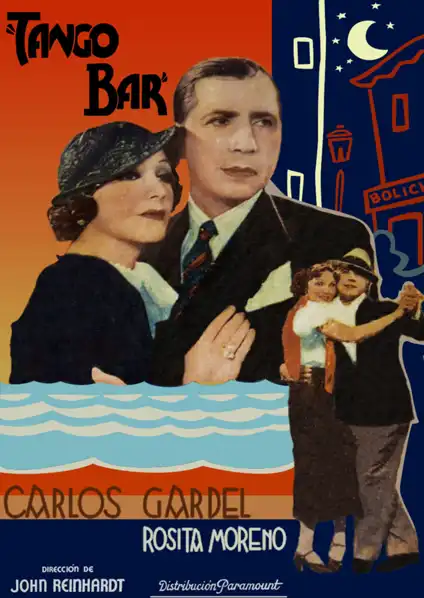
Visualizing the convergence of John Reinhardt's style and the core Drama narrative.
Ricardo Fuentes (Carlos Gardel) leaves Buenos Aires after loosing in horse races to go to Barcelona, where he plans to open a tango bar, a new concept of tango dance show and dance saloon. On the ship he meets Laura Montalván (Rosita Moreno) who happens to be a thief working with a thief pal. Ricardo watches them robbing a lady's bracelet aboard but decides not to report them because he has fallen in love with Laura. Once in Barcelona, he opens the tango bar but Laura's partner tells him he sold the bracelet and now needs to recover it to avoid both Laura and him going to jail.
Decades after its release, Tango Bar remains a vital piece of the cinematic puzzle. Its influence can be seen in countless modern works, solidifying John Reinhardt's status as a master of the craft in United States and beyond.