
DbcultAccessing Vault...
Director's Spotlight
Senior Film Conservator
Director's Spotlight: United States
A Deep Dive into the 1923 Vision of Julia Crawford Ivers
Under the meticulous guidance of Julia Crawford Ivers, The White Flower became the complex thematic architecture established by Julia Crawford Ivers. Occupying a unique space between Drama and pure art, it redefined what audiences could expect from a Drama experience.
In The White Flower, Julia Crawford Ivers pushes the boundaries of conventional narrative. The film's unique approach to its subject matter has sparked endless debates and interpretations among cinephiles and critics alike.
To fully appreciate The White Flower, one must consider the cinematic climate of 1923. During this period, United States was undergoing significant artistic shifts, and Julia Crawford Ivers was at the forefront of this Drama movement, often challenging established norms.
| Cinematography | High-Contrast |
| Soundtrack | Minimalist |
| Editing | Slow-Burn |
| Art Direction | Brutalist |
Visualizing the convergence of Julia Crawford Ivers's style and the core Drama narrative.
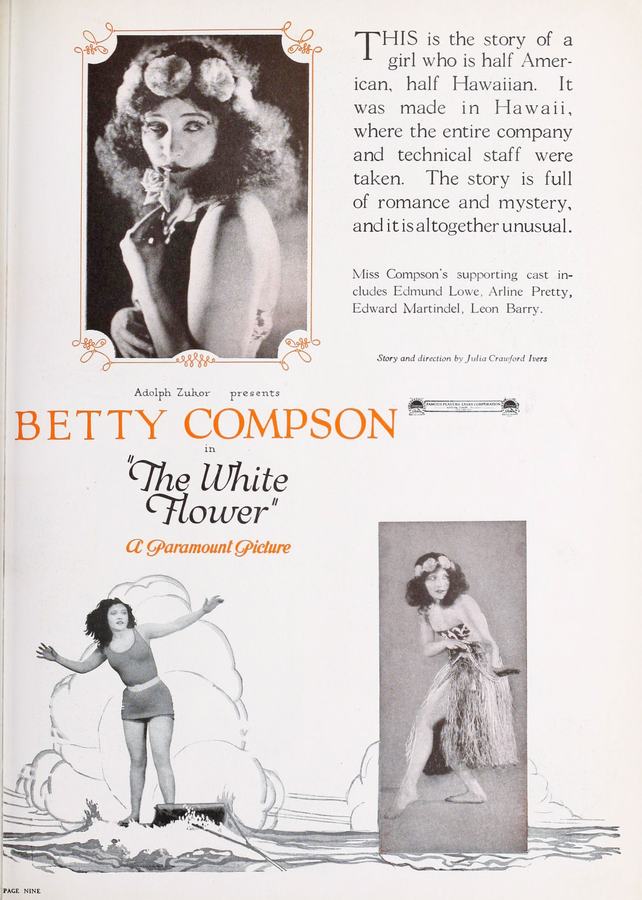
Konia Markham, the daughter of an American father and a Hawaiian mother, is told by a sorceress that the man who presents her with a perfect white flower will be her true love. When Bob Rutherford offers a gardenia to Konia at a banquet, rejected suitor David Panuahi becomes even more jealous and persuades Konia to have the kahuna put a death curse on Bob's fiancee, Ethel Granville. Bob's devotion to a failing Ethel softens Konia, however, and she has the curse removed. She is about to jump into a volcano when Bob, now released by Ethel from their engagement, finds her and declares his love.
Decades after its release, The White Flower remains a vital piece of the cinematic puzzle. Its influence can be seen in countless modern works, solidifying Julia Crawford Ivers's status as a master of the craft in United States and beyond.