
DbcultAccessing Vault...
Director's Spotlight
Senior Film Conservator
Director's Spotlight: United States
A Deep Dive into the 1918 Vision of Julius Steger
Exploring the cult underpinnings of Just a Woman leads us to the stylistic boundaries pushed by Julius Steger during the production. Through a lens of existential fatalism and cult tropes, it continues to spark endless debates among critics and cinephiles alike.

In Just a Woman, Julius Steger pushes the boundaries of conventional narrative. The film's unique approach to its subject matter has sparked endless debates and interpretations among cinephiles and critics alike.
| Cinematography | High-Contrast |
| Soundtrack | Minimalist |
| Editing | Slow-Burn |
| Art Direction | Brutalist |
Visualizing the convergence of Julius Steger's style and the core cult narrative.
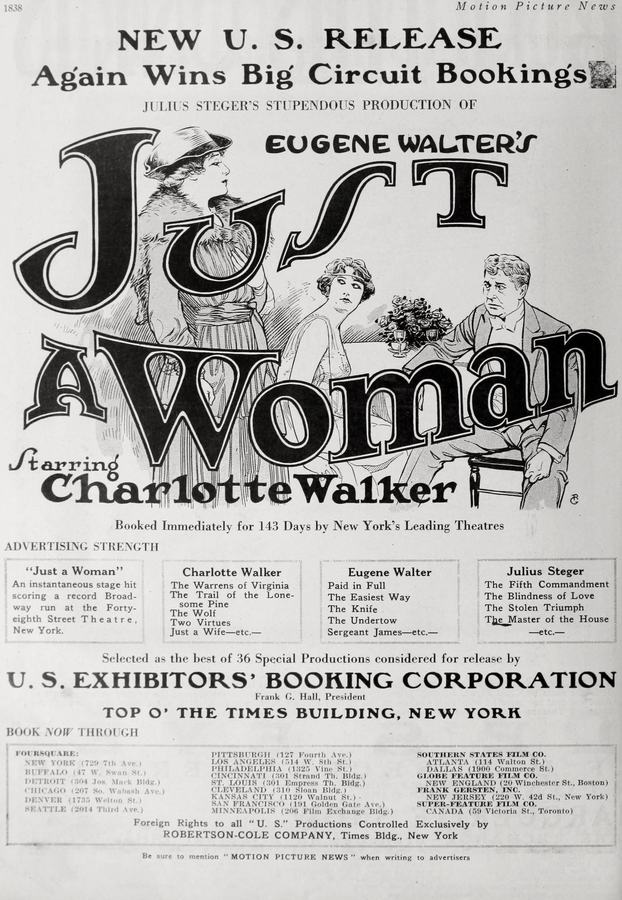
Anna Ward struggles to help her husband Jim, a laborer in a Pittsburgh steel mill, to improve his lot in life. When Jim's friend invents an improved rail-making device, Anna convinces her husband to invest his savings in the machine's promotion and marketing. This proves so successful that Jim is made a director of the steel company, but because of his strong stand on workingmen's rights, the company officials conspire to ruin him. Under the influence of a co-director, Jim resumes his old drinking habit and becomes involved in an affair with a beautiful woman, who induces him to sue Anna for divorce on a false charge of infidelity. Anna refuses to defend herself until the court threatens to take away her son, whereupon she claims that Jim is not the boy's father. Deeply ashamed, Jim confesses everything to the court and is sentenced to prison. After his release, he returns to Anna, just as their son departs to fight in World War I.
Decades after its release, Just a Woman remains a vital piece of the cinematic puzzle. Its influence can be seen in countless modern works, solidifying Julius Steger's status as a master of the craft in United States and beyond.