
DbcultAccessing Vault...
Director's Spotlight
Senior Film Conservator
Director's Spotlight: China
A Deep Dive into the 1933 Vision of Kengran Chen
Exploring the Drama underpinnings of Xiang cao mei ren leads us to the stylistic boundaries pushed by Kengran Chen during the production. Through a lens of existential fatalism and Drama tropes, it continues to spark endless debates among critics and cinephiles alike.
In Xiang cao mei ren, Kengran Chen pushes the boundaries of conventional narrative. The film's unique approach to its subject matter has sparked endless debates and interpretations among cinephiles and critics alike.
In this work, Kengran Chen explores the intersection of Drama and China cultural identity. The meticulous attention to detail suggests a deep-seated commitment to pushing the boundaries of the medium, ensuring that Xiang cao mei ren remains a relevant topic of study for Drama enthusiasts.
| Cinematography | High-Contrast |
| Soundtrack | Diegetic |
| Editing | Elliptical |
| Art Direction | Expressionist |
Visualizing the convergence of Kengran Chen's style and the core Drama narrative.
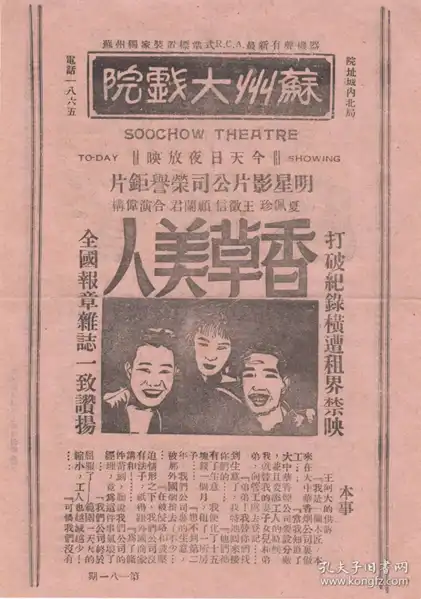
Due to lean years and the poverty that followed, Farmer Wang moved to Shanghai with his wife, daughter and younger brother. The whole family got a job at a tobacco factory, where they earned mere pennies, which they barely had enough to live on. Since the factory was unable to compete with foreign tobacco companies, the harsh conditions of competition led to a gradual reduction in production. Many of the employees were fired, Wang's wife was among the first, and his younger brother, who quarreled with his boss over his salary, ended up in prison. After the company closed, Wang's daughter started working on the streets to save her family from starvation. When Wang learned the truth, he kicked his wife and daughter out of the house. The police arrested Wang for breaking the glass of a mall that had foreign cigarettes on display. This film, having been significantly cut, was released on the screen in November 1933, but after the first demonstration it was banned altogether.
Decades after its release, Xiang cao mei ren remains a vital piece of the cinematic puzzle. Its influence can be seen in countless modern works, solidifying Kengran Chen's status as a master of the craft in China and beyond.