
DbcultAccessing Vault...
Director's Spotlight
Senior Film Conservator
Director's Spotlight: United States
A Deep Dive into the 1935 Vision of Lambert Hillyer
In the storied career of Lambert Hillyer, Behind the Evidence stands as a the provocative questions that Lambert Hillyer poses to the United States audience. Elevating the source material through Lambert Hillyer's unique vision, it persists as a haunting reminder of our own cinematic history.
In Behind the Evidence, Lambert Hillyer pushes the boundaries of conventional narrative. The film's unique approach to its subject matter has sparked endless debates and interpretations among cinephiles and critics alike.
In this work, Lambert Hillyer explores the intersection of Romance and United States cultural identity. The meticulous attention to detail suggests a deep-seated commitment to pushing the boundaries of the medium, ensuring that Behind the Evidence remains a relevant topic of study for Romance enthusiasts.
| Cinematography | High-Contrast |
| Soundtrack | Diegetic |
| Editing | Rhythmic |
| Art Direction | Naturalist |
Visualizing the convergence of Lambert Hillyer's style and the core Romance narrative.
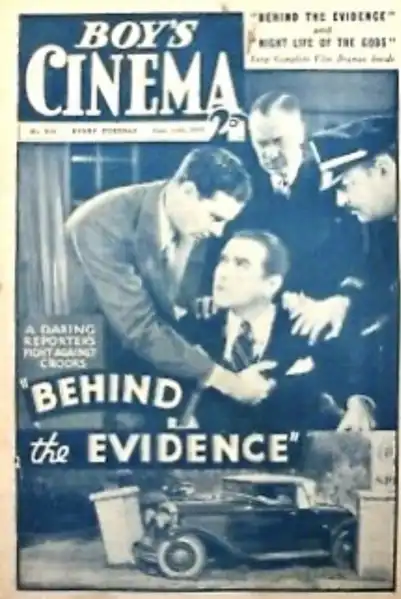
Millionaire playboy Tony Sheridan suddenly loses his fortune and, faced with working for a living, decides to become a newspaperman. He is hired by Hackett, the city editor, who assigns him to the society column. Tony's first job is to cover the engagement celebration of Ruth Allen, a banker's daughter and Tony's former fiance. She is now engaged to Ward Cameron, a broker of dubious character whom Tony dislikes. During the party, Tony realizes that Ruth's feelings for him have not changed. He also happens to pick up a cigarette case in which he finds a slip of paper with "Aztec 10" written on it. The next day, the Aztec Tire Company is robbed at 10:00 a.m., and startled by the coincidence, Tony questions Ruth about the cigarette case. He learns from her that the case belongs to Cameron. Tony suspects that Cameron is behind the series of robberies that culminated in the raid on Aztec, and visits his office, where he overhears that the Dayton Steel Company is to be the next target. Tony informs the police, who prepare a trap, thereby killing two of the would-be robbers and capturing another. Tony becomes a hero, and the publicity surrounding his actions causes police captain Graham to fear for his life and assign a detective to protect him. Two gunmen escape after unsuccessfully trying to shoot Tony, and the beleaguered reporter is pressured by Graham to reveal the identity of the gang's leader. Not wishing to hurt Ruth unnecessarily, Tony asks Graham to wait until he has gathered conclusive evidence. After warning him to leave town, Tony agrees to meet with Cameron to discuss the matter further, but Cameron sends another hit-man to dispose of him. Tony struggles with the man, who is finally chased off by the detective. Meanwhile, the police obtain a confession from Cameron's right-hand man, but the broker has disappeared by the time Graham reaches his office. Soon after, Tony is visited by Cameron's former secretary, Rita Sinclair, who promises to take him to the gang's hideout. Although the police try to follow, Rita and a henchman kidnap Tony and take him to a roadhouse, where Cameron confronts him. The police discover the trail, however, and arrive in time to prevent Cameron from murdering Tony. The gang is then rounded up with the use of tear gas and machine guns, and Cameron dies while trying to escape. Tony and Ruth are reunited, and happily promise to stick together.
Decades after its release, Behind the Evidence remains a vital piece of the cinematic puzzle. Its influence can be seen in countless modern works, solidifying Lambert Hillyer's status as a master of the craft in United States and beyond.