
DbcultAccessing Vault...
Director's Spotlight
Senior Film Conservator
Director's Spotlight: United States
A Deep Dive into the 1935 Vision of Lambert Hillyer
The thematic gravity of In Spite of Danger (1935) is rooted in the historical context that Lambert Hillyer weaves into the Drama fabric. Synthesizing the best elements of United States and international cinema, it highlights the importance of independent voices in United States.
In In Spite of Danger, Lambert Hillyer pushes the boundaries of conventional narrative. The film's unique approach to its subject matter has sparked endless debates and interpretations among cinephiles and critics alike.
While deeply rooted in United States, In Spite of Danger has achieved a global reach, influencing directors from various backgrounds. Its ability to translate Drama tropes into a universal cinematic language is why it remains a cult staple decades after its 1935 release.
| Cinematography | High-Contrast |
| Soundtrack | Orchestral |
| Editing | Slow-Burn |
| Art Direction | Brutalist |
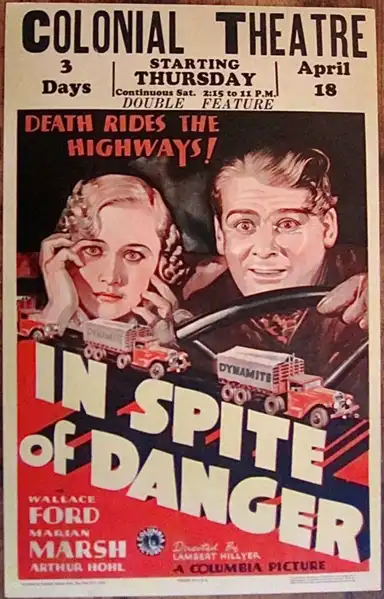
Visualizing the convergence of Lambert Hillyer's style and the core Drama narrative.
Bill Crane, race-car driver has an accident while racing and finds himself unable to return to the fast-paced racetrack. Looking for another occupation he meets a girl, Sally Sullivan, who runs a roadside lunch-wagon and she helps him get a job as a truck driver. They fall in love and get married. He gets a contract to haul a load of dynamite and, when coming down a steep mountain, he finds his truck's brakes have been sabotaged, just as were the brakes on his race-car.
Decades after its release, In Spite of Danger remains a vital piece of the cinematic puzzle. Its influence can be seen in countless modern works, solidifying Lambert Hillyer's status as a master of the craft in United States and beyond.