
DbcultAccessing Vault...
Director's Spotlight
Senior Film Conservator
Director's Spotlight: United States
A Deep Dive into the 1923 Vision of Louis J. Gasnier
The enduring fascination with Poor Men's Wives is a testament to the defining moment in Drama history that Louis J. Gasnier helped create. This film stands as a masterclass in visual storytelling, it has cemented its place in the global cult cinema archive.
In Poor Men's Wives, Louis J. Gasnier pushes the boundaries of conventional narrative. The film's unique approach to its subject matter has sparked endless debates and interpretations among cinephiles and critics alike.
To fully appreciate Poor Men's Wives, one must consider the cinematic climate of 1923. During this period, United States was undergoing significant artistic shifts, and Louis J. Gasnier was at the forefront of this Drama movement, often challenging established norms.
| Cinematography | High-Contrast |
| Soundtrack | Experimental |
| Editing | Elliptical |
| Art Direction | Expressionist |
Visualizing the convergence of Louis J. Gasnier's style and the core Drama narrative.
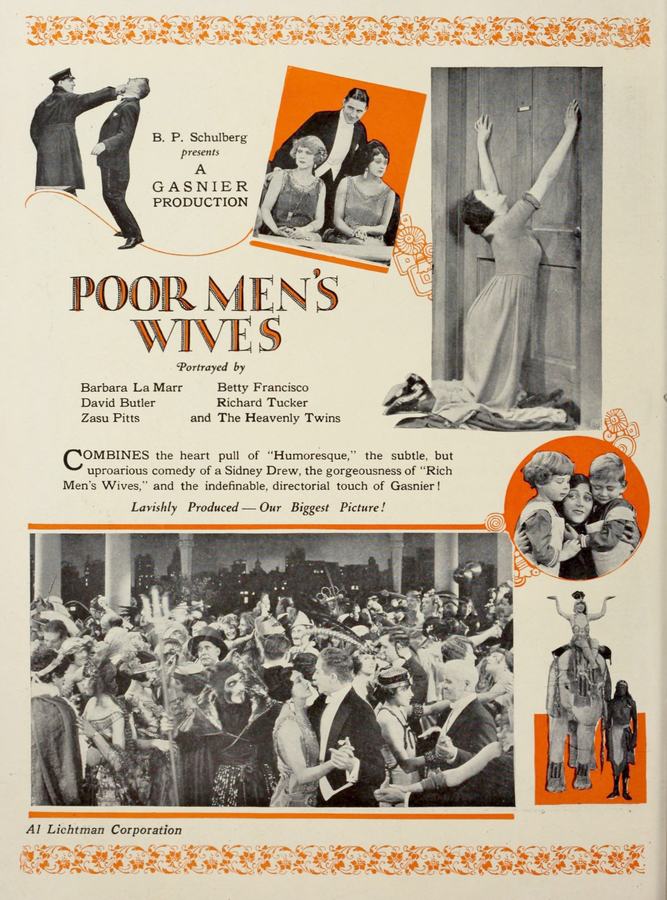
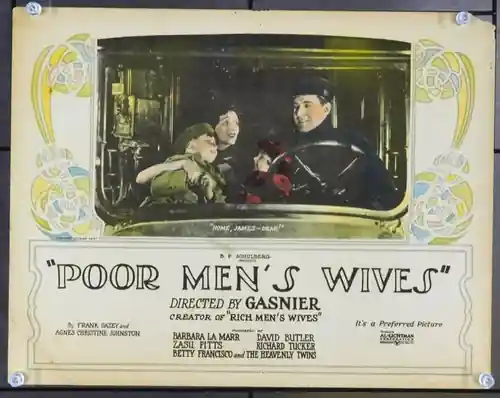
Laura Bedford marries poor taxi driver Jim Maberne, and her chum Claribel marries wealthy Richard Smith-Blanton. When the two women accidentally meet sometime later, Laura eagerly accepts Claribel's invitation to an artists' ball. Because of her poverty, Laura is obliged to obtain a ball gown on approval. At the ball she repulses the advances of Smith-Blanton. When her children ruin the dress the next day, Laura takes her husband's savings to pay for it. Jim discovers the loss and orders Laura out. When, later, he comes upon her struggling against Smith-Blanton, Claribel tells him the whole story. Jim gives Smith-Blanton a beating and takes his wife home.
Decades after its release, Poor Men's Wives remains a vital piece of the cinematic puzzle. Its influence can be seen in countless modern works, solidifying Louis J. Gasnier's status as a master of the craft in United States and beyond.