
DbcultAccessing Vault...
Director's Spotlight
Senior Film Conservator
Director's Spotlight: United States
A Deep Dive into the 1935 Vision of Louis King
Witnessing the stylistic transformation of Comedy through Julieta Buys a Son reveals the global recognition that Louis King garnered after the release of Julieta Buys a Son. Serving as a mirror to the anxieties of a changing world, offering layers of thematic complexity that demand repeated viewing.
In Julieta Buys a Son, Louis King pushes the boundaries of conventional narrative. The film's unique approach to its subject matter has sparked endless debates and interpretations among cinephiles and critics alike.
To fully appreciate Julieta Buys a Son, one must consider the cinematic climate of 1935. During this period, United States was undergoing significant artistic shifts, and Louis King was at the forefront of this Comedy movement, often challenging established norms.
| Cinematography | Noir-Inspired |
| Soundtrack | Diegetic |
| Editing | Rhythmic |
| Art Direction | Naturalist |
Visualizing the convergence of Louis King's style and the core Comedy narrative.
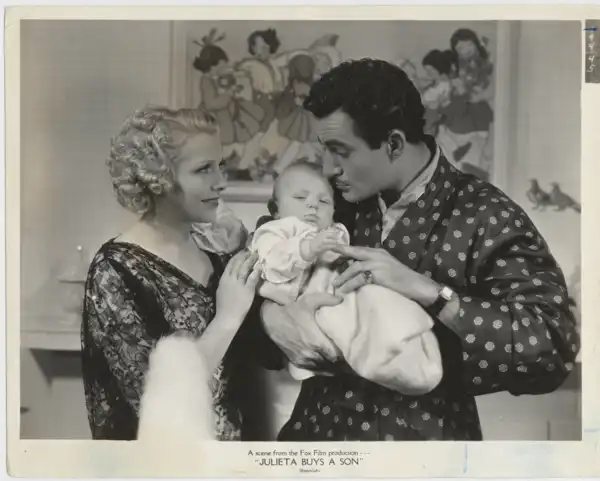
On her wedding day, Julieta Albornoz reveals that she has waited her whole life to wed because men in the past have always desired her for her money. When another woman, Isabel, arrives to inform Julieta that Antonio, Julieta's fiance, has fathered her child and promised to continue to support them with his wife-to-be's money, a despondent Julieta runs off on a cruise with her friend Cecilia. While she pedals an exercise bike on deck, she meets Jack Aranda, and the two are instantly drawn to each other, though they do not exchange names. Jack's aunt, a duchess, discovers that the rich Julieta is on the ship and encourages her nephew to woo her, as he has fallen into financial hard times. Jack admits that he has fallen in love with another, but agrees to his aunt's plan nonetheless. When Jack and his younger cousin Guillermo approach Julieta and Cecilia at a masquerade ball with the intention of seducing the rich young woman, Julieta tells Jack that he has mistaken her for Cecilia, who has money. Jack then approaches Cecilia with the same words of love, and Julieta rebukes him for his greed, but later invites him to her cabin with a business proposition. She offers Jack a sum to marry her and to help her conceive a son, after which they would divorce. Jack reluctantly agrees and hopes that the two will love each other eventually and have a real marriage. Julieta treats Jack coldly throughout their honeymoon in Biarritz, and when she suspects erroneously that he is having an affair, she asks that he take her away somewhere. At his family's home in the province of Burgos, he insists that she pretend to be his happy bride, but when he tells her that he loves her, she demands that they leave the house. Their car crashes, and they are placed in the same bed in order to recover. Months later, Julieta has a daughter and asks Jack to go away now that he has fulfilled his contract. Jack, who shows extraordinary devotion and love to his child, tells Julieta that the contract is not binding as she had a daughter, and he must help her to have a son. He returns to her the uncashed check that she had originally given to him in payment for his services, declares his devotion and promises to stay with her until she has a son. Julieta agrees, and the two spend the night together like a happily married couple, Julieta finally finding a man whose love is not self-interested.
Decades after its release, Julieta Buys a Son remains a vital piece of the cinematic puzzle. Its influence can be seen in countless modern works, solidifying Louis King's status as a master of the craft in United States and beyond.