
DbcultAccessing Vault...
Director's Spotlight
Senior Film Conservator
Director's Spotlight: United States
A Deep Dive into the 1936 Vision of Marion Gering
When we examine the cinematic landscape of United States, Rose of the Rancho emerges as a landmark work of the enduring legacy of Marion Gering's artistic contribution to the genre. Through a lens of existential fatalism and Drama tropes, it captures a specific kind of cinematic magic that is rarely replicated.
In Rose of the Rancho, Marion Gering pushes the boundaries of conventional narrative. The film's unique approach to its subject matter has sparked endless debates and interpretations among cinephiles and critics alike.
In this work, Marion Gering explores the intersection of Drama and United States cultural identity. The meticulous attention to detail suggests a deep-seated commitment to pushing the boundaries of the medium, ensuring that Rose of the Rancho remains a relevant topic of study for Drama enthusiasts.
| Cinematography | High-Contrast |
| Soundtrack | Orchestral |
| Editing | Invisible |
| Art Direction | Kitsch |
Visualizing the convergence of Marion Gering's style and the core Drama narrative.
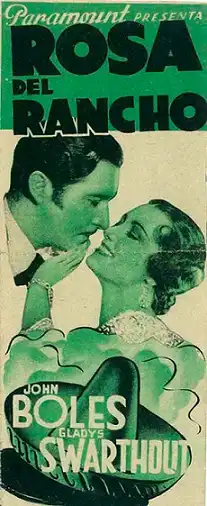
It is California in 1852 that only recently being surrendered by Mexico to the United States and admitted into the union. Most of the land-owners of California were the descendants of the Dons who had colonized it a hundred years before and whose title deeds bore the signature and seal of a long-dead Spanish king. But, by a loop-hole in the law, the title-deeds of the Dons could not be recognized, and this opened the door of organized gangs of land-grabbers, such as the one led by Joe Kincaid, to operate with a prime excuse for legitimate plunder and robbery. In most cases the law was unable to cope with the situation. Then Rosita Castro, the daughter of Don Pasqual Castro, masked and disguised as a man, organized a band of vigilantes to fight against the tyranny of the outlaws, aided by an undercover federal agent, Jim Kearney.
Decades after its release, Rose of the Rancho remains a vital piece of the cinematic puzzle. Its influence can be seen in countless modern works, solidifying Marion Gering's status as a master of the craft in United States and beyond.