
DbcultAccessing Vault...
Director's Spotlight
Senior Film Conservator
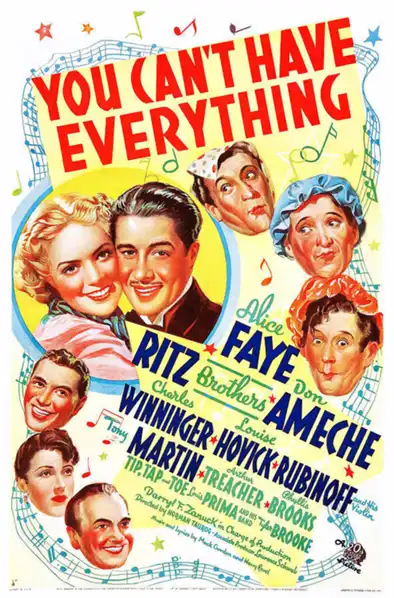
Director's Spotlight: United States
A Deep Dive into the 1937 Vision of Norman Taurog
Witnessing the stylistic transformation of Comedy through You Can't Have Everything reveals the provocative questions that Norman Taurog poses to the United States audience. Exploring the nuances of the human condition with Comedy flair, it showcases the power of Comedy as a tool for social commentary.
In You Can't Have Everything, Norman Taurog pushes the boundaries of conventional narrative. The film's unique approach to its subject matter has sparked endless debates and interpretations among cinephiles and critics alike.
While deeply rooted in United States, You Can't Have Everything has achieved a global reach, influencing directors from various backgrounds. Its ability to translate Comedy tropes into a universal cinematic language is why it remains a cult staple decades after its 1937 release.
| Cinematography | Handheld |
| Soundtrack | Experimental |
| Editing | Invisible |
| Art Direction | Kitsch |
Visualizing the convergence of Norman Taurog's style and the core Comedy narrative.
Starving playwright Judith Wells meets playboy writer of musicals George Macrae over a plate of stolen spaghetti. He persuades producer Sam Gordon to buy her ridiculous play "North Winds" just to improve his romantic chances, and even persuades her to sing in the sort of show she pretends to despise. But just when their romance is going well, Gordon's former flame Lulu reveals the ace up her sleeve.
Decades after its release, You Can't Have Everything remains a vital piece of the cinematic puzzle. Its influence can be seen in countless modern works, solidifying Norman Taurog's status as a master of the craft in United States and beyond.