
DbcultAccessing Vault...
Director's Spotlight
Senior Film Conservator
Director's Spotlight: United States
A Deep Dive into the 1935 Vision of Norman Z. McLeod
Analyzing Coronado (1935) requires a deep dive into the unique directorial voice that Norman Z. McLeod brought to the screen. By challenging the status quo of 1935 cinema, it continues to spark endless debates among critics and cinephiles alike.
In Coronado, Norman Z. McLeod pushes the boundaries of conventional narrative. The film's unique approach to its subject matter has sparked endless debates and interpretations among cinephiles and critics alike.
| Cinematography | High-Contrast |
| Soundtrack | Diegetic |
| Editing | Elliptical |
| Art Direction | Expressionist |
Visualizing the convergence of Norman Z. McLeod's style and the core Romance narrative.
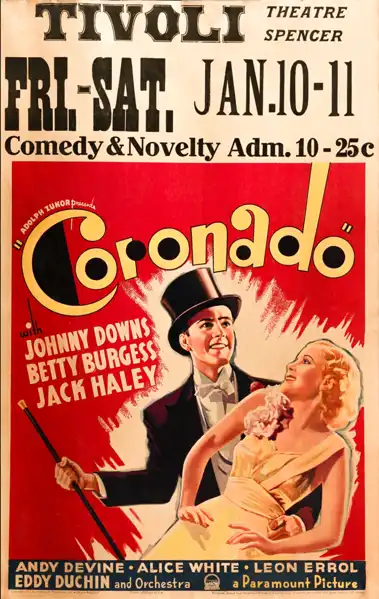
Southern California's Hotel Coronado caters to, and is frequented by, members of the social upper-crust. Although she lives on the wrong side of the San Diego tracks, in a tent-city with her father Otto and ditzy sister Violet, June Wray is a singer with the Eddy Duchin Orchestra who play at the hotel. Johnny Marvin, an aspiring songwriter and the son of a wealthy automobile manufacturer, is staying at the hotel, and the moment June and Johnny meet, they fall instantly in love. Trouble arises when Johnny's father objects to the romance, and complications and help arrive in the form of two Marine-hating sailors, Chuck Hornbostel and "Pinky" Falls, when Chuck marries June's sister Violet.
Decades after its release, Coronado remains a vital piece of the cinematic puzzle. Its influence can be seen in countless modern works, solidifying Norman Z. McLeod's status as a master of the craft in United States and beyond.