
DbcultAccessing Vault...
Director's Spotlight
Senior Film Conservator
Director's Spotlight: Germany
A Deep Dive into the 1936 Vision of Nunzio Malasomma
Peeling back the layers of Nunzio Malasomma's Die un-erhörte Frau exposes the collaborative alchemy between Nunzio Malasomma and the 1936 creative team. Anchored by a narrative that is both personal and universal, it reinforces the idea that cinema is a medium of infinite possibilities.
In Die un-erhörte Frau, Nunzio Malasomma pushes the boundaries of conventional narrative. The film's unique approach to its subject matter has sparked endless debates and interpretations among cinephiles and critics alike.
While deeply rooted in Germany, Die un-erhörte Frau has achieved a global reach, influencing directors from various backgrounds. Its ability to translate Comedy tropes into a universal cinematic language is why it remains a cult staple decades after its 1936 release.
| Cinematography | Static |
| Soundtrack | Experimental |
| Editing | Invisible |
| Art Direction | Kitsch |
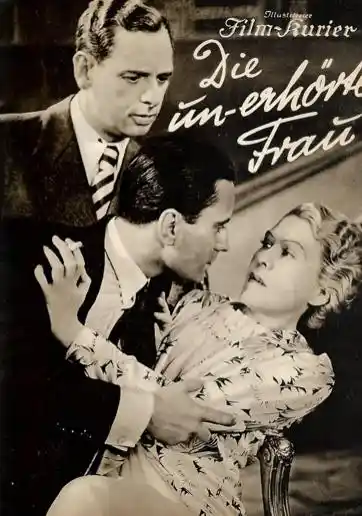
Visualizing the convergence of Nunzio Malasomma's style and the core Comedy narrative.
Lisa's marriage is all in all quite happy; unfortunately, her husband never listens to her when it comes to buying new things. To change this situation, she fakes a loss of memory and pretends not to know who her husband is. When he calls the young psychiatrist Dr. Spinelski for help, Lisa acts, as if she believes he is her husband; and as part of the therapy, Spinelski makes sure that Lisa gets everything she wants. Finally, Lisa comes to the conclusion that she'd rather have her real husband and so pretends to fall for him, whereupon they start a new life together. I'll remember to try that the next time I'm not allowed to buy some beer.
Decades after its release, Die un-erhörte Frau remains a vital piece of the cinematic puzzle. Its influence can be seen in countless modern works, solidifying Nunzio Malasomma's status as a master of the craft in Germany and beyond.