
DbcultAccessing Vault...
Director's Spotlight
Senior Film Conservator
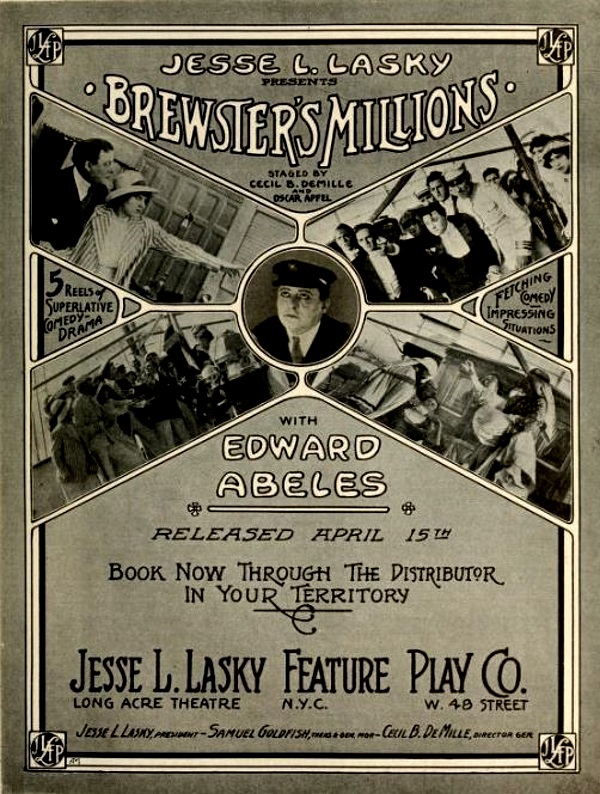
Director's Spotlight: United States
A Deep Dive into the 1914 Vision of Oscar Apfel
The 1914 release of Brewster's Millions marked a significant moment for the stylistic boundaries pushed by Oscar Apfel during the production. In the context of United States's rich cinematic history, it invites us to question our own perceptions of cult narratives.
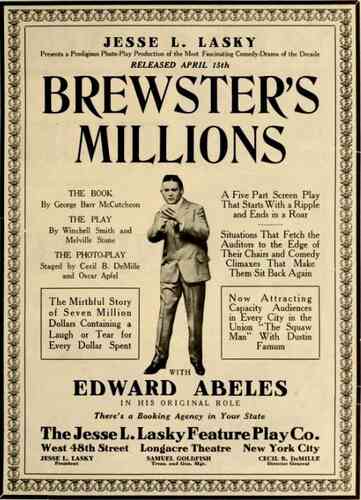
In Brewster's Millions, Oscar Apfel pushes the boundaries of conventional narrative. The film's unique approach to its subject matter has sparked endless debates and interpretations among cinephiles and critics alike.
| Cinematography | Noir-Inspired |
| Soundtrack | Orchestral |
| Editing | Slow-Burn |
| Art Direction | Brutalist |
Visualizing the convergence of Oscar Apfel's style and the core cult narrative.
Robert Brewster, scion of a well-to-do family, elopes with Louise Sedgewick. Peter Brewster disinherits Robert and refuses to be reconciled to the marriage, and later drives the young couple from their home. A little son, "Monty," blesses the union. When Monty is a full-grown man, Peter Brewster dies and bequeaths a million dollars to him. The newly-acquired wealth staggers young Monty Brewster, and he is about to launch into the new life as one of the predatory rich when he receives a communication from an attorney in the West, advising him that his uncle, George Brewster, has left him $7 million, contingent upon his getting rid of the million dollars left him by Peter Brewster. "Peter Brewster mistreated your mother and father and I do not want you to touch a dollar of his money. If you spend the million left to you by him and can, at the end of a year, show by receipts that you have judiciously spent, not squandered this million dollars, my attorneys will turn over to you my worldly possessions, aggregating seven millions. You must own nothing of value at the end of the year," said George Brewster, and Monty, learning for the first time that Peter Brewster had mistreated his parents, begins to spend the million. He invests the money in a sure losing proposition in Wall Street in an effort to dispose of some of his unwelcome money, and the proposition turns out a winner. He backs a flabby fat pugilist, hoping to lose, and wins. There is a clause in the will of George Brewster which says that Monty must not tell anyone of his desire to spend the million and his friends think he has suddenly lost his mind. Everything Monty touches with the hope of losing some of his money, turns out just the reverse, and he wins. He has a most terrible time disposing of the undesired millions. Finally, in a desperate attempt at magnificent spending, Monty hires a palatial yacht, invites several dozen friends to accompany him and goes on a long cruise. The friends mutiny in mid-ocean, thinking him suddenly insane the way he is squandering his wealth, and threaten to lock Monty up, but Monty, to frustrate them, runs up a signal of distress. It costs him two hundred thousand dollars to be salvaged by a passing steamer, and the end of the year rolls around with Monty flat broke. He has squandered the entire million dollars, possesses a room full of receipts to show for every dollar spent, and his sweetheart, Peggy, believing him to be a pauper, consents to marry him. His friends, believing him broke, endeavor to press money and jewelry upon him, all of which he must not have in his possession or he loses the seven million. He dodges his friends, is met by the attorney and presented with seven million dollars, and everything turns out happily.
Decades after its release, Brewster's Millions remains a vital piece of the cinematic puzzle. Its influence can be seen in countless modern works, solidifying Oscar Apfel's status as a master of the craft in United States and beyond.