
DbcultAccessing Vault...
Director's Spotlight
Senior Film Conservator
Director's Spotlight: United States
A Deep Dive into the 1920 Vision of Paul Powell
Exploring the Drama underpinnings of Sweet Lavender leads us to the stylistic boundaries pushed by Paul Powell during the production. Through a lens of existential fatalism and Drama tropes, it continues to spark endless debates among critics and cinephiles alike.
In Sweet Lavender, Paul Powell pushes the boundaries of conventional narrative. The film's unique approach to its subject matter has sparked endless debates and interpretations among cinephiles and critics alike.
While deeply rooted in United States, Sweet Lavender has achieved a global reach, influencing directors from various backgrounds. Its ability to translate Drama tropes into a universal cinematic language is why it remains a cult staple decades after its 1920 release.
| Cinematography | High-Contrast |
| Soundtrack | Experimental |
| Editing | Invisible |
| Art Direction | Kitsch |
Visualizing the convergence of Paul Powell's style and the core Drama narrative.
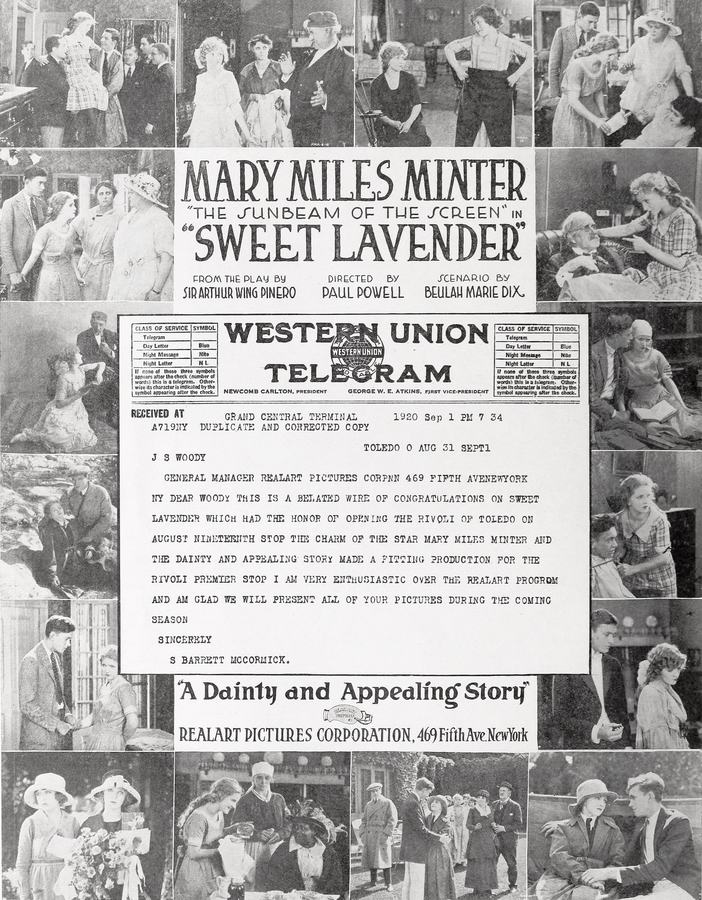
Ruth Holt, owner of a boardinghouse in a small college town, lives with her pretty niece "Sweet Lavender," who believes that Ruth is her mother. When boarder Clem Hale, president of the freshman class, is the victim of a prank played by several of his classmates, Lavender rescues him and the two fall in love. Clem's guardian, Horace Weatherburn, becomes concerned about his ward's adoration for a "commoner" and arrives to break up their romance. Ruth, who recognizes Washburn as Lavender's real father and the man who brought her sister grief, strongly opposes the match and sends Lavender off to boarding school. Upon learning that Clem is seriously ill, Lavender runs away to comfort her sweetheart and, in her plight, faints by the side of the road. Weatherburn finds her and is so touched by her concern, that he relents his previous disapproval. Ruth then reveals Lavender's parentage to her father who offers his blessing to the couple.
Decades after its release, Sweet Lavender remains a vital piece of the cinematic puzzle. Its influence can be seen in countless modern works, solidifying Paul Powell's status as a master of the craft in United States and beyond.