
DbcultAccessing Vault...
Director's Spotlight
Senior Film Conservator
Director's Spotlight: United States
A Deep Dive into the 1918 Vision of Paul Scardon
The evocative power of Hoarded Assets stems from the unique collaboration between the subversive storytelling techniques employed by Paul Scardon in 1918. Synthesizing the best elements of United States and international cinema, it reminds us of the fragility and beauty of the 1918s.
In Hoarded Assets, Paul Scardon pushes the boundaries of conventional narrative. The film's unique approach to its subject matter has sparked endless debates and interpretations among cinephiles and critics alike.
In this work, Paul Scardon explores the intersection of cult and United States cultural identity. The meticulous attention to detail suggests a deep-seated commitment to pushing the boundaries of the medium, ensuring that Hoarded Assets remains a relevant topic of study for cult enthusiasts.
| Cinematography | Handheld |
| Soundtrack | Diegetic |
| Editing | Rhythmic |
| Art Direction | Naturalist |
Visualizing the convergence of Paul Scardon's style and the core cult narrative.
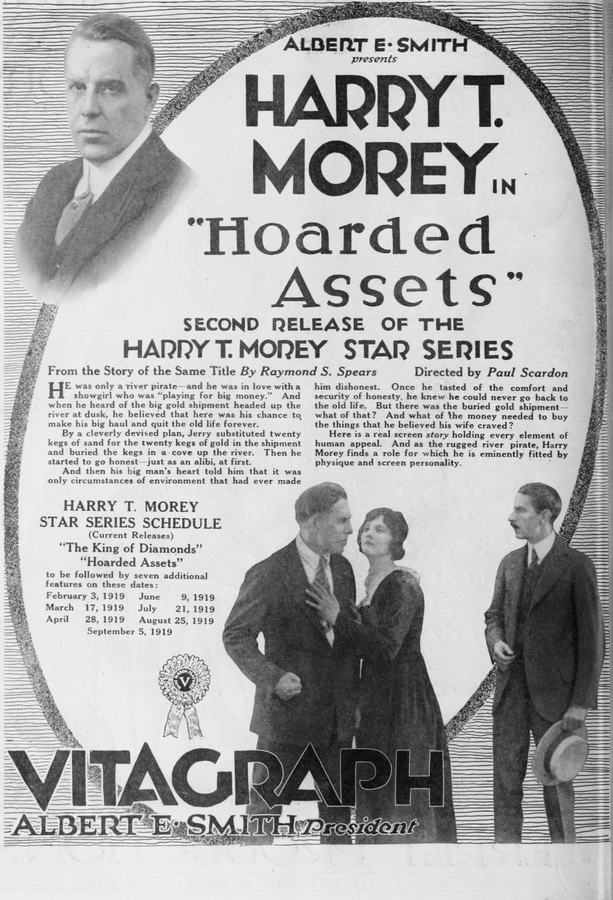
Jerry Rufus, a river pirate, loves Claire Dawson, an actress, but because she has so many wealthy suitors, he incorrectly believes she plans to marry for money. Jerry learns that a large gold shipment secretly stored in nail kegs is to be delivered to a certain dock, and by substituting kegs of sand for the ones containing gold, he succeeds in obtaining the treasure and sinking it near the shore. When he proposes to Claire, he is astonished to learn that she has always loved him, and the two marry. Soon, however, Detective Ryan, who has been trailing Jerry for some time, convinces Claire to badger her husband for money. Anxious to please her, Jerry digs up the kegs, and as he is about to open one, Ryan appears. Ryan is discouraged and Jerry relieved to find that the barrel contains only sand, the pirate having stolen the wrong kegs.
Decades after its release, Hoarded Assets remains a vital piece of the cinematic puzzle. Its influence can be seen in countless modern works, solidifying Paul Scardon's status as a master of the craft in United States and beyond.