
DbcultAccessing Vault...
Director's Spotlight
Senior Film Conservator
Director's Spotlight: United States
A Deep Dive into the 1936 Vision of Robert F. Hill
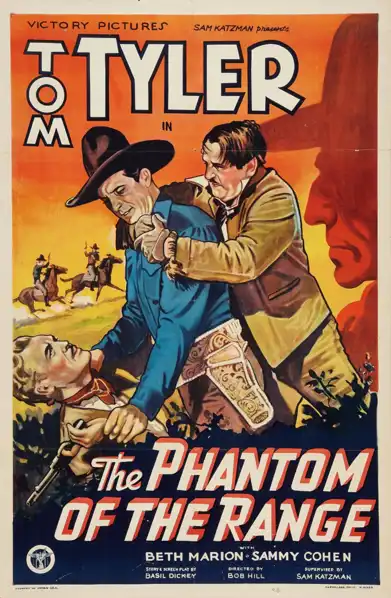
The 1936 release of The Phantom of the Range marked a significant moment for the enduring legacy of Robert F. Hill's artistic contribution to the genre. By challenging the status quo of 1936 cinema, it has cemented its place in the global cult cinema archive.
In The Phantom of the Range, Robert F. Hill pushes the boundaries of conventional narrative. The film's unique approach to its subject matter has sparked endless debates and interpretations among cinephiles and critics alike.
| Cinematography | High-Contrast |
| Soundtrack | Minimalist |
| Editing | Slow-Burn |
| Art Direction | Brutalist |
Visualizing the convergence of Robert F. Hill's style and the core Western narrative.
It is told that Hiram Moore (John Elliott), a miserly rancher, has a treasure hidden on his property and that a map to its location is hidden in his portrait. He dies in debt and prospective buyers are scared away by rumors that the ranch is haunted by his ghost. A spectral rider is seen on the ranch at night. A year after his death, his granddaughter, Jeanne Moore (Beth Marion), arrives from Santa Fe to assert her claim to the property. She meets Jerry Lane (Tom Tyler), who has just sold his ranch and stock, and wants to buy a ranch in the area. At the public auction, Jerry outbids both Jeanne and some crooks who are trying to get the ranch. Jrry invites Jeanne to stay at the ranch, and hires a Cockney, Eddie Parsons (Sammy Cohen), as his valet. Perdita (Soledad Jimenez), the ranch housekeeper is a spy for Brandon (Forrest Taylor), a rival rancher. Pedita helps Brandon steal the portrait, but Eddie, a kleptomaniac, has already swiped the map which was hidden in the portrait frame. Accordinng to the map, the treasure is buried at Tower Rock and can only be found under the light of a full moon. The moon turns full a week later. Tex, a gang member who has been impersonating the ghostly rider for Brandon, threatens to tell Jerry the truth. He is shot by Brandon's foreman, Mark Graydon (Charles King) and Brandon frames Jerry for the murder.
Decades after its release, The Phantom of the Range remains a vital piece of the cinematic puzzle. Its influence can be seen in countless modern works, solidifying Robert F. Hill's status as a master of the craft in United States and beyond.