
DbcultAccessing Vault...
Director's Spotlight
Senior Film Conservator
Director's Spotlight: United States
A Deep Dive into the 1936 Vision of Robert Florey
In the storied career of Robert Florey, Till We Meet Again stands as a the provocative questions that Robert Florey poses to the United States audience. Elevating the source material through Robert Florey's unique vision, it persists as a haunting reminder of our own cinematic history.
In Till We Meet Again, Robert Florey pushes the boundaries of conventional narrative. The film's unique approach to its subject matter has sparked endless debates and interpretations among cinephiles and critics alike.
| Cinematography | High-Contrast |
| Soundtrack | Diegetic |
| Editing | Rhythmic |
| Art Direction | Naturalist |
Visualizing the convergence of Robert Florey's style and the core War narrative.
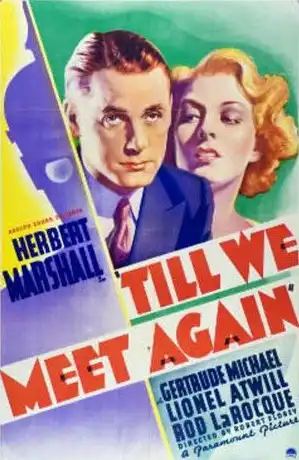
In August 1914 London, Austrian star Elsa Duranyi (Gertrude Michael) and English matinee idol Alan Barclay (Herbert Marshall) are in love and plan to marry immediately. But the War comes and Elsa mysteriously disappears. Alan's ease in speaking German results in his appointment to the British Intelligence and, to aid his use as a spy, they announce he was killed in action. He takes the name and personality of "shell-shocked" German prisoner Hans Teller and is sent into Germany on an exchange of prisoners. Elsa, now a spy in the service of the Fatherland, is in Monte Carlo, where Allied officers on leave can be tempted into revealing war secrets. In Germany, Alan, posing as Teller, is listed as unfit for service, contacts Carl Schrottle (Rod LaRocque), another British agent. They are to locate the German "Big Bertha," the long-range gun bombarding Paris. They are successful and the gun is destroyed. Elsa is recalled and given the assignment of locating the British spy organization and its members. Through her surveillance of Carl, she meets Hans Teller and recognizes him as Alan, but doesn't let on. Alone, she agrees to flee to Holland with him but her superior officer, Ludwig (Lionel Atwill), is not fooled and is in pursuit.
Decades after its release, Till We Meet Again remains a vital piece of the cinematic puzzle. Its influence can be seen in countless modern works, solidifying Robert Florey's status as a master of the craft in United States and beyond.