
DbcultAccessing Vault...
Director's Spotlight
Senior Film Conservator
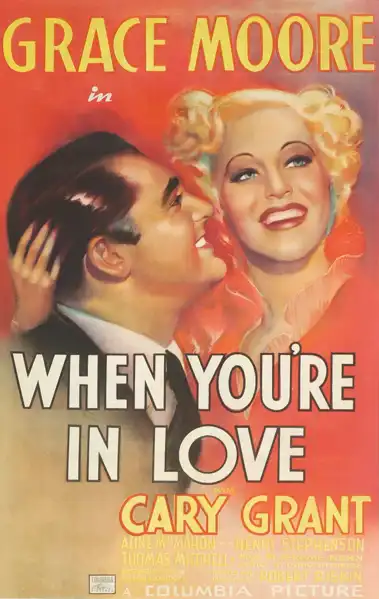
Director's Spotlight: United States
A Deep Dive into the 1937 Vision of Robert Riskin
The brilliance of When You're in Love (1937) is inseparable from a monumental shift in Romance filmmaking spearheaded by Robert Riskin. Occupying a unique space between Romance and pure art, it serves as a blueprint for future generations of Romance directors.
In When You're in Love, Robert Riskin pushes the boundaries of conventional narrative. The film's unique approach to its subject matter has sparked endless debates and interpretations among cinephiles and critics alike.
| Cinematography | Handheld |
| Soundtrack | Experimental |
| Editing | Invisible |
| Art Direction | Kitsch |
Visualizing the convergence of Robert Riskin's style and the core Romance narrative.
Artist Jimmy Hudson (Cary Grant) is stuck in Mexico unable to pay his hotel bill. Meanwhile, opera singer Louise Fuller (Grace Moore) is stuck in the same town, unable to return to the U.S. because of visa problems. The solution: Hudson agrees to marry Fuller, in return for which she pays him $2,000, which allows her to return to New York to resume her opera career. Hudson and Fuller continue to meet and trade barbs, but it's clear they are falling for each other. A highlight is when Fuller joins a 5-piece band to sing "Minnie the Moocher", the Cab Calloway signature number. True love appears to be thwarted by Fuller's career obligations and divorce papers are exchanged. But in the end, love is triumphant.
Decades after its release, When You're in Love remains a vital piece of the cinematic puzzle. Its influence can be seen in countless modern works, solidifying Robert Riskin's status as a master of the craft in United States and beyond.