
DbcultAccessing Vault...
Director's Spotlight
Senior Film Conservator
Director's Spotlight: Italy
A Deep Dive into the 1913 Vision of Roberto Roberti
Deciphering the layers of The Mystery of St. Martin's Bridge (1913) reveals the complex thematic architecture established by Roberto Roberti. Utilizing a 1913-specific aesthetic that remains timeless, it stands as the definitive 1913 statement on cult identity.
In The Mystery of St. Martin's Bridge, Roberto Roberti pushes the boundaries of conventional narrative. The film's unique approach to its subject matter has sparked endless debates and interpretations among cinephiles and critics alike.
To fully appreciate The Mystery of St. Martin's Bridge, one must consider the cinematic climate of 1913. During this period, Italy was undergoing significant artistic shifts, and Roberto Roberti was at the forefront of this cult movement, often challenging established norms.
| Cinematography | Static |
| Soundtrack | Orchestral |
| Editing | Slow-Burn |
| Art Direction | Brutalist |
Visualizing the convergence of Roberto Roberti's style and the core cult narrative.
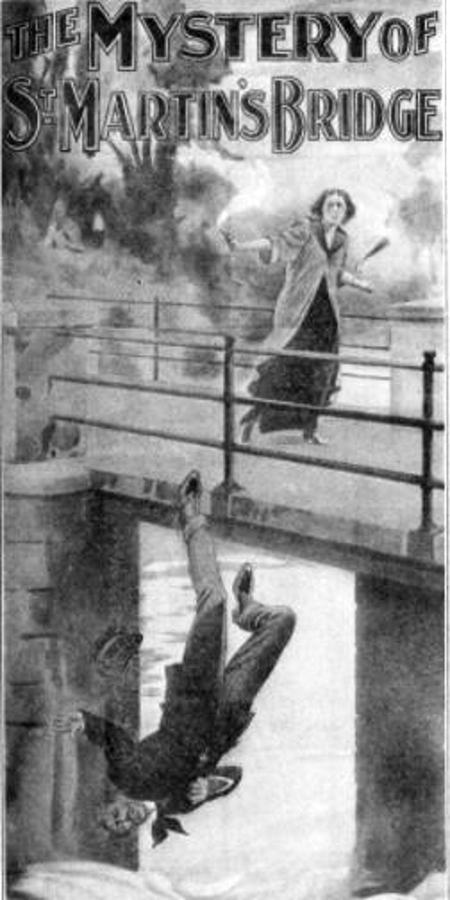
Our picture opens with a beautiful mountain scene and Cora, the belle of a mountain tribe, decking herself with garlands of roses. In the evening Lord Martagne, in disguise, appears at the cave of the mountain tribe and is fascinated by Cora's weird dance. They become lovers, but Lord Martagne soon wearies of the mountain girl and discards her. She calls at his home but is repulsed. She enters secretly at a masked ball in fancy costume to kill her unfaithful lover, but is foiled by his having left the city on urgent business. Lord Martagne goes on important business of a diplomatic character, and becomes a guest at the home of Irma, an attractive young woman who is engaged to be married. Irma is fascinated by Lord Martagne. Cora, the mountain girl, starts out in search of her unfaithful lover. She discovers him seated in a box at the theater with Irma. She leaves the theater when he does and follows him to his home. On account of financial difficulties Lord Martagne writes a letter to Irma, whose father has recently died, leaving her a fortune. He leaves the letter on his desk and Cora, who enters the house, finds it. The note asks Irma to meet him on St. Martin's Bridge the next night and loan him $5,000. Cora meets Lord Martagne on the bridge and forces him to fight a pistol duel with her. She kills him and he falls from the bridge into the river below. Irma comes to keep the appointment and looking over the rail of the bridge sees the body of her lover below. Then she finds the pistol lying on the bridge and her mind gives way. She is crazed and in her delirium she imagines that she committed the murder. At her home. Albert Norton, her fiancé, listens to her story, which is overheard by a maid. He advises her to leave and escape punishment. The maid informs the police and Irma and Norton are arrested. Then Irma recovers her mind and tries to prove her innocence, but fails. She and Norton are condemned to death. In the meantime, Cora has become a famous dancer. She learns of the conviction of Norton and Irma. It worries her greatly and on account of her high strung nerves, she falls into the fire while executing a wild fire dance and is terribly burned. When lying in bed she reads that the execution is about to take place and she confesses and insists on being taken to the scene of the execution in an automobile. She arrives just in time to prevent the double execution, and after telling her story, dies of excitement and exhaustion.
Decades after its release, The Mystery of St. Martin's Bridge remains a vital piece of the cinematic puzzle. Its influence can be seen in countless modern works, solidifying Roberto Roberti's status as a master of the craft in Italy and beyond.