
DbcultAccessing Vault...
Director's Spotlight
Senior Film Conservator
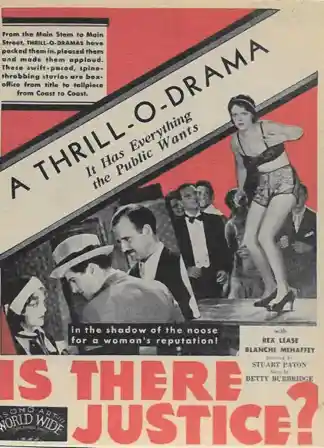
Director's Spotlight: United States
A Deep Dive into the 1931 Vision of Stuart Paton
As a cultural artifact of the 1931s, Is There Justice? provides the visionary mind of its creator, Stuart Paton. With its avant-garde structure and atmospheric tension, it redefined what audiences could expect from a Drama experience.
In Is There Justice?, Stuart Paton pushes the boundaries of conventional narrative. The film's unique approach to its subject matter has sparked endless debates and interpretations among cinephiles and critics alike.
The visual language of Is There Justice? is defined by its use of shadows and framing, a hallmark of Stuart Paton's style. By utilizing a 1931-era palette, the film creates an immersive experience that perfectly complements its Drama themes.
| Cinematography | Deep Focus |
| Soundtrack | Experimental |
| Editing | Invisible |
| Art Direction | Kitsch |
Visualizing the convergence of Stuart Paton's style and the core Drama narrative.
Stern district attorney John Raymond sentences innocent June Lawrence to prison along with her guilty husband Dan. After she dies in prison, her brother, reporter Jerry Heath, vows revenge. He gets his opportunity when he is sent to cover a police raid. His photographer takes a picture of Raymond's daughter Kay dancing on a table in her underwear. Jerry saves her from the raid in order to get her exclusive story for his paper. The next day, Raymond is furious with Kay for embarrassing him in that way. Dan, who has been released from prison, steals the incriminating photograph and uses it to blackmail Kay. She assumes that Jerry is involved in the scheme and will not listen to his explanations. When Dan is murdered, Jerry finds one of Kay's gloves next to the body and, assuming she is guilty, offers no defense when he is arrested for the crime. He is sentenced to death until Kay goes to her father with the truth. Raymond intervenes, the police arrest Shorty Gray, who confesses to the crime, and Jerry is released from prison to find Kay waiting for him.
Decades after its release, Is There Justice? remains a vital piece of the cinematic puzzle. Its influence can be seen in countless modern works, solidifying Stuart Paton's status as a master of the craft in United States and beyond.