
DbcultAccessing Vault...
Director's Spotlight
Senior Film Conservator
Director's Spotlight: United States
A Deep Dive into the 1918 Vision of T. Hayes Hunter
Exploring the cult underpinnings of Once to Every Man leads us to the stylistic boundaries pushed by T. Hayes Hunter during the production. Through a lens of existential fatalism and cult tropes, it continues to spark endless debates among critics and cinephiles alike.
In Once to Every Man, T. Hayes Hunter pushes the boundaries of conventional narrative. The film's unique approach to its subject matter has sparked endless debates and interpretations among cinephiles and critics alike.
While deeply rooted in United States, Once to Every Man has achieved a global reach, influencing directors from various backgrounds. Its ability to translate cult tropes into a universal cinematic language is why it remains a cult staple decades after its 1918 release.
| Cinematography | Static |
| Soundtrack | Experimental |
| Editing | Elliptical |
| Art Direction | Expressionist |
Visualizing the convergence of T. Hayes Hunter's style and the core cult narrative.
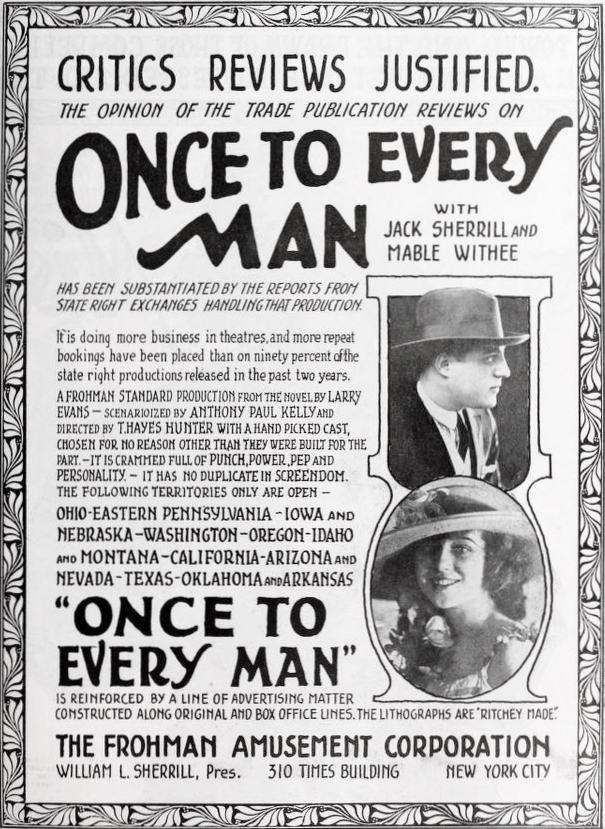
Because both his father and grandfather died of alcoholism, the inhabitants of Denny Bolton's small home town in upstate New York consider him, too, a hopeless drunkard. Swayed by the suggestion that he has inherited a craving for liquor, Denny fights to abstain from it, aided only by the woman who loves him, Dryad Anderson. One night, however, Denny is kicked by a horse, and when Dryad sees him unconscious on the floor, she believes the worst and abandons him. Angered, Denny moves to New York City and applies for a job as a fighter in Flash Hogarty's gymnasium. In the ring, Denny stands up to a good fighter named Sutton, which so impresses Flash that he trains Denny to face the lightweight champion, Jed the Red. An encouraging note from Dryad delivered to Denny during the big fight so inspires him that he defeats Jed and returns home triumphant.
Decades after its release, Once to Every Man remains a vital piece of the cinematic puzzle. Its influence can be seen in countless modern works, solidifying T. Hayes Hunter's status as a master of the craft in United States and beyond.