
DbcultAccessing Vault...
Director's Spotlight
Senior Film Conservator
Director's Spotlight: United States
A Deep Dive into the 1923 Vision of Val Paul
The artistic breakthrough represented by Crashin' Thru in 1923 highlights the philosophical inquiries that Val Paul embeds within the narrative. Framed by the hauntingly beautiful landscapes of the production, it leaves an indelible mark on the soul of the viewer.
In Crashin' Thru, Val Paul pushes the boundaries of conventional narrative. The film's unique approach to its subject matter has sparked endless debates and interpretations among cinephiles and critics alike.
The visual language of Crashin' Thru is defined by its use of shadows and framing, a hallmark of Val Paul's style. By utilizing a 1923-era palette, the film creates an immersive experience that perfectly complements its Drama themes.
| Cinematography | Handheld |
| Soundtrack | Synth-Heavy |
| Editing | Rhythmic |
| Art Direction | Naturalist |
Visualizing the convergence of Val Paul's style and the core Drama narrative.
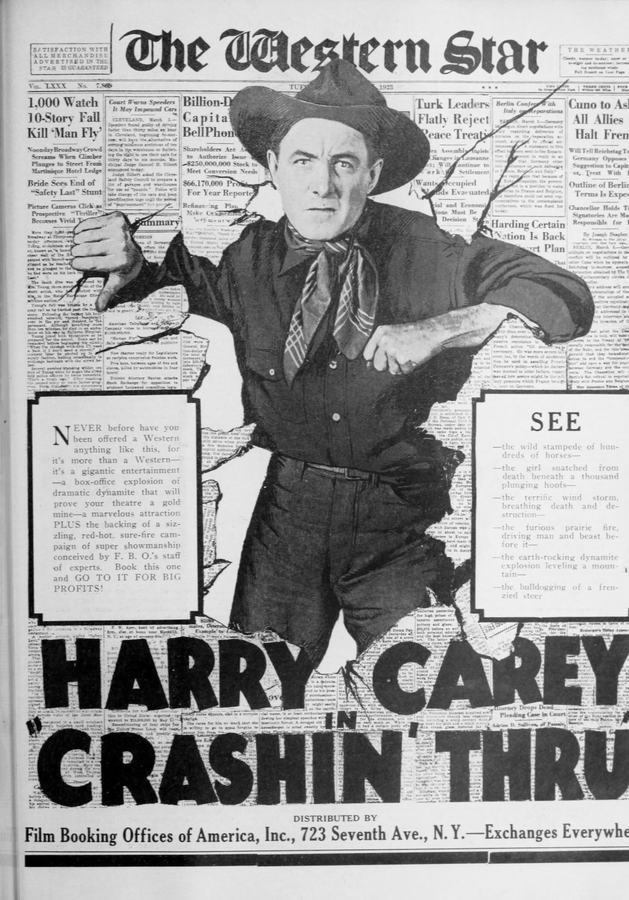
Rancher Jim Blake narrowly escapes being gored by an angry bull, thanks to his partner, Saunders, who loses the use of his legs as a result. Celia and her daughter, Diane, arrive at the ranch in response to Jim's advertisement for a wife. Although Jim declines Celia's offer, he allows her and Diane to stay at the ranch. Cons Saunders blames his father's condition on Jim and partners with a dancer named Gracia, who seeks revenge against the rancher because he is oblivious to her charms. She plots with Cons to steal Jim's cattle, leaving him unable to repay the money he owes his Uncle Benedict. When Uncle Benedict is murdered, Cons and Blake blame each other, until it is discovered that Gracia is the culprit. Saunders recovers under Celia's care, and Jim finds love with Diane.
Decades after its release, Crashin' Thru remains a vital piece of the cinematic puzzle. Its influence can be seen in countless modern works, solidifying Val Paul's status as a master of the craft in United States and beyond.