
DbcultAccessing Vault...
Director's Spotlight
Senior Film Conservator
Director's Spotlight: United States
A Deep Dive into the 1924 Vision of Victor Halperin
Deciphering the layers of When a Girl Loves (1924) reveals the complex thematic architecture established by Victor Halperin. Utilizing a 1924-specific aesthetic that remains timeless, it stands as the definitive 1924 statement on Drama identity.
In When a Girl Loves, Victor Halperin pushes the boundaries of conventional narrative. The film's unique approach to its subject matter has sparked endless debates and interpretations among cinephiles and critics alike.
The visual language of When a Girl Loves is defined by its use of shadows and framing, a hallmark of Victor Halperin's style. By utilizing a 1924-era palette, the film creates an immersive experience that perfectly complements its Drama themes.
| Cinematography | Handheld |
| Soundtrack | Minimalist |
| Editing | Disjunctive |
| Art Direction | Baroque |
Visualizing the convergence of Victor Halperin's style and the core Drama narrative.
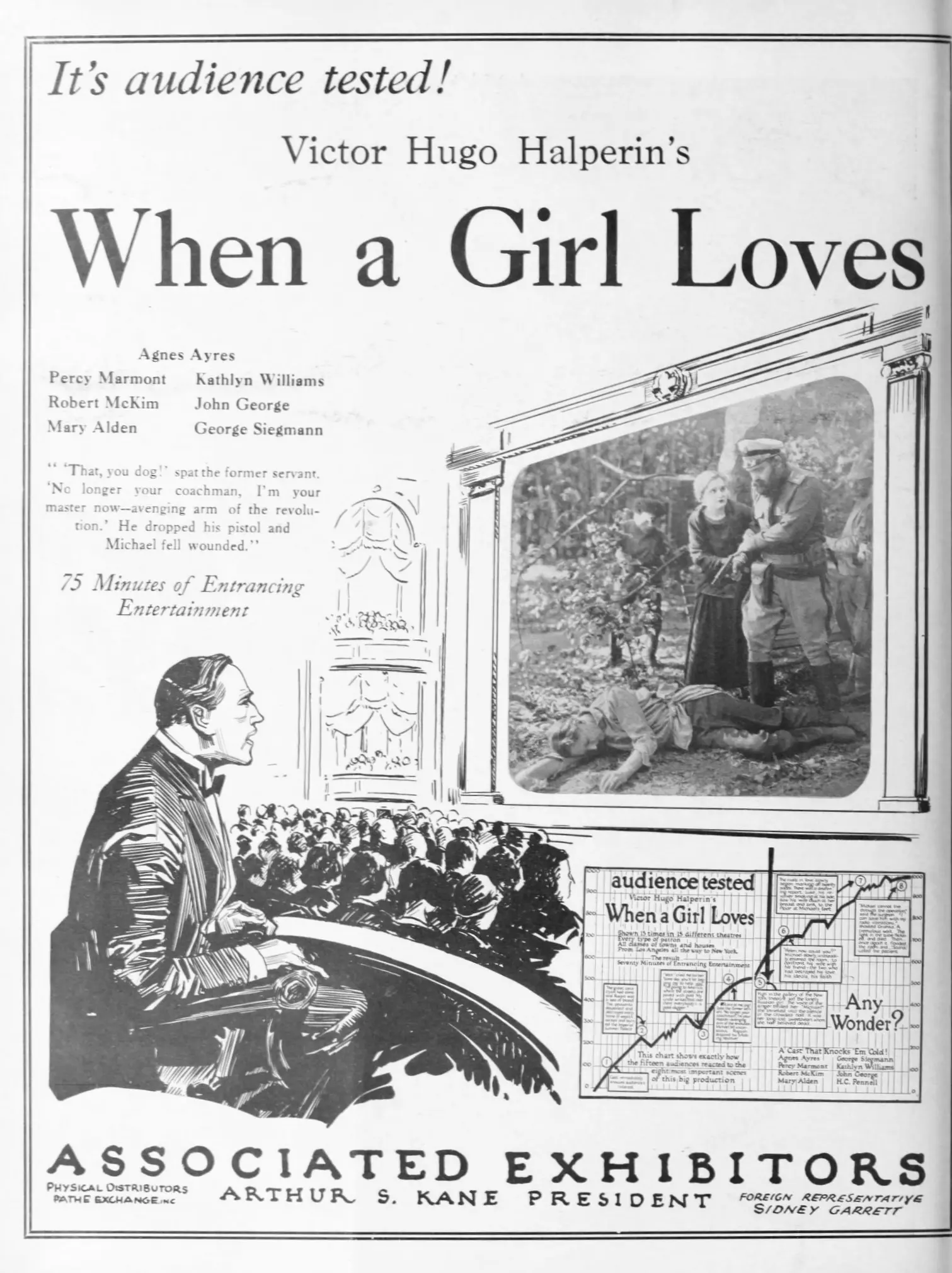
The revolution causes Sasha Boroff's wealthy family to lose its fortune; and her lover, Count Michael, is sentenced to death by Rogojin, the Boroffs' former coachman. Rogojin's sudden death saves Sasha from marriage to the despot, and the Boroffs escape to the United States, where Sasha marries Dr. Godfrey Luke to please her family. Later Sasha discovers that Michael survived, fled to the United States, and married Helen, an American. When Helen has a love affair with Dr. Luke, Michael challenges him to a duel. Sasha is wounded in the exchange of gunfire, the shock prostrates Michael, and Grishka cures him with a radio-vibration device. At the end, Sasha and Michael are still happily married to their respective American spouses.
Decades after its release, When a Girl Loves remains a vital piece of the cinematic puzzle. Its influence can be seen in countless modern works, solidifying Victor Halperin's status as a master of the craft in United States and beyond.