
DbcultAccessing Vault...
Director's Spotlight
Senior Film Conservator
Director's Spotlight: United States
A Deep Dive into the 1921 Vision of Wallace Worsley
To understand the modern evolution of United States film, one must first look at The Beautiful Liar and the meticulous attention to detail that Wallace Worsley applied to every frame. Reflecting the political and social shifts of the 1921s, it showcases the power of Drama as a tool for social commentary.
In The Beautiful Liar, Wallace Worsley pushes the boundaries of conventional narrative. The film's unique approach to its subject matter has sparked endless debates and interpretations among cinephiles and critics alike.
The visual language of The Beautiful Liar is defined by its use of shadows and framing, a hallmark of Wallace Worsley's style. By utilizing a 1921-era palette, the film creates an immersive experience that perfectly complements its Drama themes.
| Cinematography | High-Contrast |
| Soundtrack | Minimalist |
| Editing | Slow-Burn |
| Art Direction | Brutalist |
Visualizing the convergence of Wallace Worsley's style and the core Drama narrative.
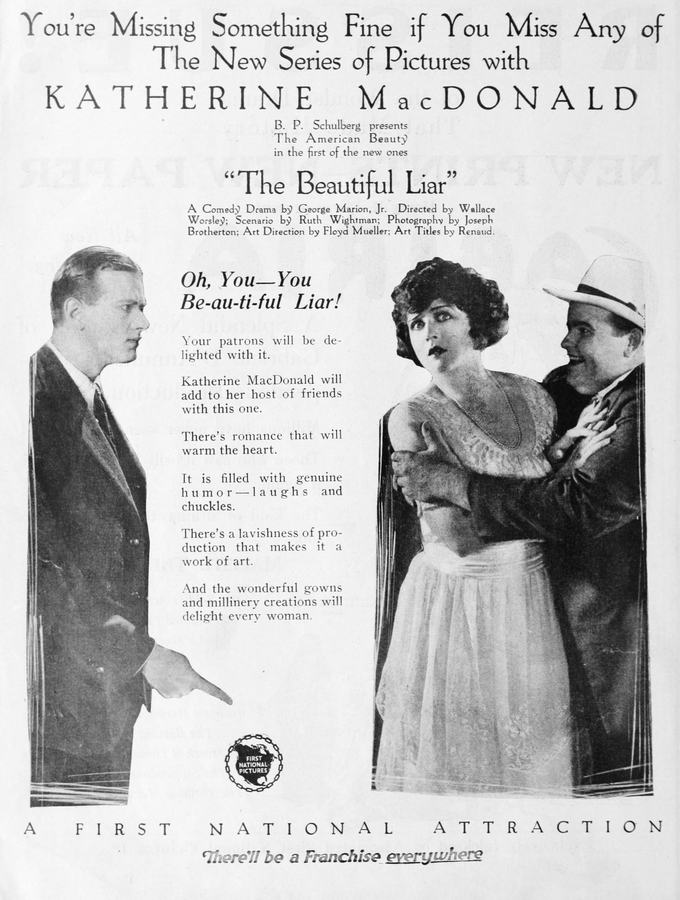
The guests at a summer resort hotel, headed by Mrs. Van Courtlandt--Van Allstyn, are preparing to stage a charity performance of a farce, and Gaston Allegretti, threatened with dismissal by the owners, has promised to obtain the services of Broadway star Elsie Parmelee. When the actress refuses, Gaston, in despair, enlists the aid of Helen Haynes, who works in a broker's office and resembles the actress. With MacGregor, a Scottish bookkeeper, she goes to the resort for what she supposes to be a vacation and is reluctant to accept an acting role until she finds that young millionaire Bobby Bates, with whom she is in love, is engaged to play opposite her; although awkward in the part, she is hailed as a great comedienne. Bobby proposes and Helen accepts, thinking he knows her true identity. Later, he learns of the real Elsie Parmelee and is disillusioned, but MacGregor admits his duplicity and all ends well.
Decades after its release, The Beautiful Liar remains a vital piece of the cinematic puzzle. Its influence can be seen in countless modern works, solidifying Wallace Worsley's status as a master of the craft in United States and beyond.