
DbcultAccessing Vault...
Director's Spotlight
Senior Film Conservator
Director's Spotlight: United States
A Deep Dive into the 1919 Vision of Webster Cullison
The thematic gravity of In for Thirty Days (1919) is rooted in the historical context that Webster Cullison weaves into the cult fabric. Synthesizing the best elements of United States and international cinema, it highlights the importance of independent voices in United States.
In In for Thirty Days, Webster Cullison pushes the boundaries of conventional narrative. The film's unique approach to its subject matter has sparked endless debates and interpretations among cinephiles and critics alike.
In this work, Webster Cullison explores the intersection of cult and United States cultural identity. The meticulous attention to detail suggests a deep-seated commitment to pushing the boundaries of the medium, ensuring that In for Thirty Days remains a relevant topic of study for cult enthusiasts.
| Cinematography | Noir-Inspired |
| Soundtrack | Synth-Heavy |
| Editing | Disjunctive |
| Art Direction | Baroque |
Visualizing the convergence of Webster Cullison's style and the core cult narrative.
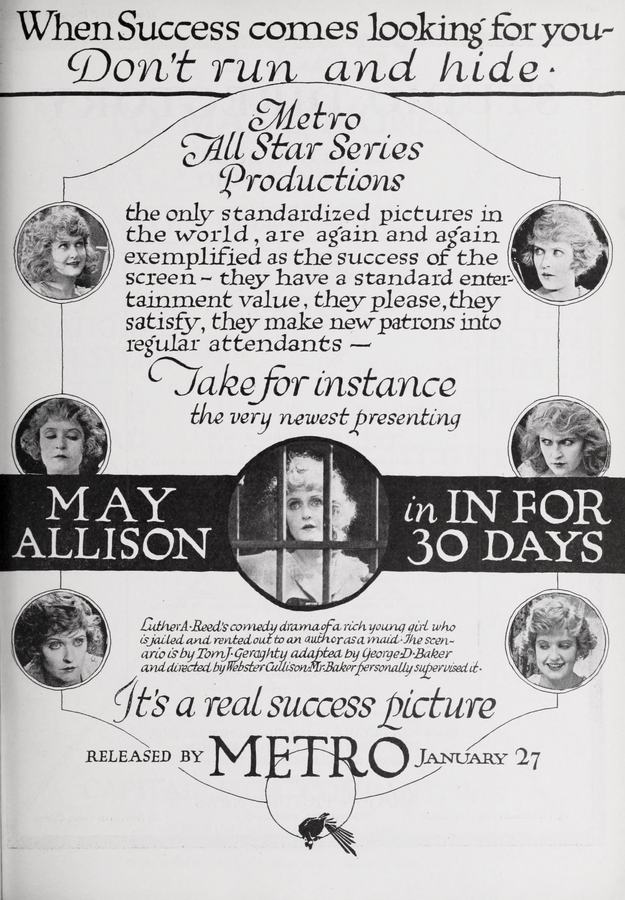
Helen Corning, a rich "Yankee" widow's daughter, antagonizes her Southern neighbors when she speeds in her roadster. After she causes Brett Page's stalled Ford to overturn, Helen rams Judge Carroll's wagon, upsetting his eggs which fly into his whiskers. Furious, the Judge sends Helen to jail for thirty days. Brett, taking advantage of the town's ancient law that allows townspeople to hire prisoners for twenty cents per day, takes the uncooperative Helen into his home to cook and clean. Learning to respect Brett who, she discovers, is an affluent author, Helen resists her mother's efforts to get her released so that she can marry the one hundred and fifteen pound Count Dronsky. After Mrs. Corning and Dronsky hire "Hot Stove" Kelly to break Helen out and take her across state lines, Helen runs Kelly's car into Brett's bungalow. Brett thrashes Kelly, and while Mrs. Corning and Dronsky pursue, he and Helen are married in the car, by a judge riding on the hood.
Decades after its release, In for Thirty Days remains a vital piece of the cinematic puzzle. Its influence can be seen in countless modern works, solidifying Webster Cullison's status as a master of the craft in United States and beyond.