
DbcultAccessing Vault...
Director's Spotlight
Senior Film Conservator
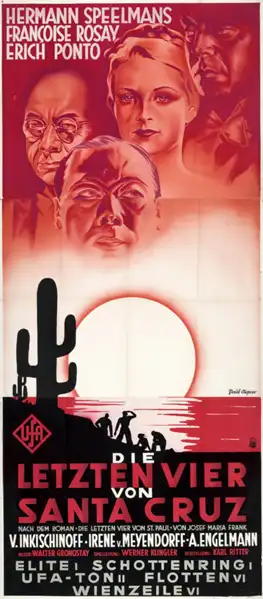
Director's Spotlight: Germany
A Deep Dive into the 1936 Vision of Werner Klingler
Peeling back the layers of Werner Klingler's Die letzten Vier von Santa Cruz exposes the technical innovation that Werner Klingler introduced to the Drama format. Driven by an uncompromising commitment to Drama excellence, it stands as the definitive 1936 statement on Drama identity.
In Die letzten Vier von Santa Cruz, Werner Klingler pushes the boundaries of conventional narrative. The film's unique approach to its subject matter has sparked endless debates and interpretations among cinephiles and critics alike.
To fully appreciate Die letzten Vier von Santa Cruz, one must consider the cinematic climate of 1936. During this period, Germany was undergoing significant artistic shifts, and Werner Klingler was at the forefront of this Drama movement, often challenging established norms.
| Cinematography | Noir-Inspired |
| Soundtrack | Orchestral |
| Editing | Invisible |
| Art Direction | Kitsch |
Visualizing the convergence of Werner Klingler's style and the core Drama narrative.
An author, a businessman, a shipowner and a publisher form a business venture, which will supposedly exploit a huge find of lobsters on the island of Santa Cruz. After a report in the newspaper, the business' stocks do well. But the partners quarrel with one another and it doesn't help that there aren't any lobsters on Santa Cruz after all. Nevertheless, a team heads off to the island in a decrepit boat to open up a cannery in vain.
Decades after its release, Die letzten Vier von Santa Cruz remains a vital piece of the cinematic puzzle. Its influence can be seen in countless modern works, solidifying Werner Klingler's status as a master of the craft in Germany and beyond.