
DbcultAccessing Vault...
Director's Spotlight
Senior Film Conservator
Director's Spotlight: United States
A Deep Dive into the 1934 Vision of Wesley Ruggles
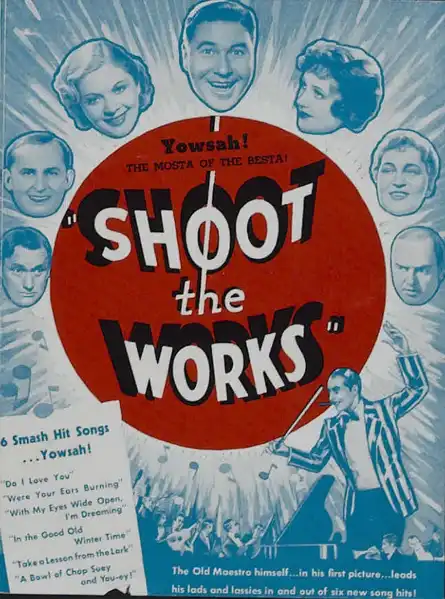
Few works in United States cinema carry the same weight as Shoot the Works, especially regarding the cultural zeitgeist captured so perfectly by Wesley Ruggles in 1934. Utilizing a 1934-specific aesthetic that remains timeless, it serves as a blueprint for future generations of Musical directors.
In Shoot the Works, Wesley Ruggles pushes the boundaries of conventional narrative. The film's unique approach to its subject matter has sparked endless debates and interpretations among cinephiles and critics alike.
To fully appreciate Shoot the Works, one must consider the cinematic climate of 1934. During this period, United States was undergoing significant artistic shifts, and Wesley Ruggles was at the forefront of this Musical movement, often challenging established norms.
| Cinematography | Handheld |
| Soundtrack | Minimalist |
| Editing | Disjunctive |
| Art Direction | Baroque |
Visualizing the convergence of Wesley Ruggles's style and the core Musical narrative.
Nicky Nelson runs a small carnival on New York's 42nd Street under the auspices of Nicky Nelson Enterprises, which consists of Joe Davis and his band, stunt man "Sailor" Burke and his gold digger wife Jackie, and The Countess, a matronly woman who takes tickets at Nicky's various attractions. Down on his luck with a profitless whale attraction, Nicky, at heart a songwriter, tries to audition for vaudeville agent Axel Hanratty, who turns him out. In Hanratty's offices, however, Nicky meets blonde singer Lily Racquel. Lily, impressed with Nicky's song, asks him to drum up a vaudeville act with her and gives him a ring to hock to purchase an act. Instead, Nicky, a compulsive gambler and foolish idealist, loses Lily's money shooting craps with Hanratty, then tells her he bought the act. Joe, his band, Sailor and Jackie then abandon Nicky's outfit, and Joe borrows Lily for his nightclub act. Nicky and Lily improve the lyrics on his song and swear their love; however, in an attempt to win back Lily's ring so he can propose, Nicky loses both it and the song to Hanratty. During Joe's opening show at the Yellow Dragon Cafe, Lily sings Nicky's song, and Hanratty, in the audience with radio man Alvin Ritchie, decides to hire the band and the girl. When Ritchie offers Lily a chance to sing the song on a radio broadcast, she insists Nicky be included, but Hanratty reminds her he now owns the song. Lily turns her back on Nicky, and she and Joe replace gossip columnist Larry Hale's "Broadway Chatter" segment on Ritchie's radio program and are a big success. Joe then advances to the Varsity Club, a collegiate bar, and finally opens his own nightclub, the Club Kent. Ritchie, meanwhile, courts Lily, while Nicky works at a flea circus, slowly earning enough money to buy back Lily's ring. When she receives it, she visits Nicky, who tells her he doesn't want her back and is leaving for Iowa in the morning, to join the Bartow Wonder Shows. The Countess then convinces Nicky to spend his last night in New York with the old gang at Joe's opening at Club Kent. There, Ritchie has Joe announce his engagement to Lily, whom he expects to give up her work after marriage. When Nicky hears the announcement, he runs out. Hale then learns of the old romance between Nicky and Lily and approaches Nicky for fuel for his scandal sheet, but Nicky socks him and he lands in the hospital. Struck by Nicky's love for Lily, Hale turns soft and uses his broadcasting powers to blackmail Ritchie into backing out of the marriage. Lily and Nicky marry and he becomes the new emcee for Ritchie's show.
Decades after its release, Shoot the Works remains a vital piece of the cinematic puzzle. Its influence can be seen in countless modern works, solidifying Wesley Ruggles's status as a master of the craft in United States and beyond.