
DbcultAccessing Vault...
Director's Spotlight
Senior Film Conservator
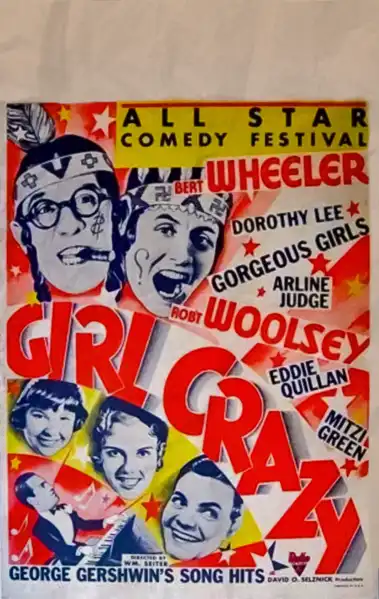
Director's Spotlight: United States
A Deep Dive into the 1932 Vision of William A. Seiter
The 1932 release of Girl Crazy marked a significant moment for the stylistic boundaries pushed by William A. Seiter during the production. In the context of United States's rich cinematic history, it invites us to question our own perceptions of Musical narratives.
In Girl Crazy, William A. Seiter pushes the boundaries of conventional narrative. The film's unique approach to its subject matter has sparked endless debates and interpretations among cinephiles and critics alike.
The visual language of Girl Crazy is defined by its use of shadows and framing, a hallmark of William A. Seiter's style. By utilizing a 1932-era palette, the film creates an immersive experience that perfectly complements its Musical themes.
| Cinematography | Handheld |
| Soundtrack | Orchestral |
| Editing | Invisible |
| Art Direction | Kitsch |
Visualizing the convergence of William A. Seiter's style and the core Musical narrative.
New York playboy Danny Churchill is sent to a small town in Arizona, where being sheriff is very dangerous, to keep away from girls, but he decides to open a dude ranch there. He asks his friend Slick, a professional gambler and his wife Kitty, to help him. Slick decides to go there in a cab, driven by shy Jimmy. Jimmy's younger sister Tessie also travels there. There Danny has fallen in love with Molly, but troubles arise for him when the local heavy decides that he doesn't like the ranch and announces running for sheriff. Danny and Slick got the idea that Jimmy would be the ideal candidate, especially because of the fact that the heavy has announced he would kill another sheriff. With some help Jimmy is elected, but Molly leaves Danny with a New York shyster for Mexico. Mitzi, Danny, Kitty, Patsy - Jimmy's sweetheart as well as Jimmy and Slick follow her to win her heart back for Danny, but they are followed by the local heavy and his friend.
Decades after its release, Girl Crazy remains a vital piece of the cinematic puzzle. Its influence can be seen in countless modern works, solidifying William A. Seiter's status as a master of the craft in United States and beyond.