
DbcultAccessing Vault...
Director's Spotlight
Senior Film Conservator
Director's Spotlight: United States
A Deep Dive into the 1915 Vision of William C. Dowlan
Peeling back the layers of William C. Dowlan's The College Orphan exposes the collaborative alchemy between William C. Dowlan and the 1915 creative team. Anchored by a narrative that is both personal and universal, it reinforces the idea that cinema is a medium of infinite possibilities.
In The College Orphan, William C. Dowlan pushes the boundaries of conventional narrative. The film's unique approach to its subject matter has sparked endless debates and interpretations among cinephiles and critics alike.
To fully appreciate The College Orphan, one must consider the cinematic climate of 1915. During this period, United States was undergoing significant artistic shifts, and William C. Dowlan was at the forefront of this cult movement, often challenging established norms.
| Cinematography | Static |
| Soundtrack | Orchestral |
| Editing | Slow-Burn |
| Art Direction | Brutalist |
Visualizing the convergence of William C. Dowlan's style and the core cult narrative.
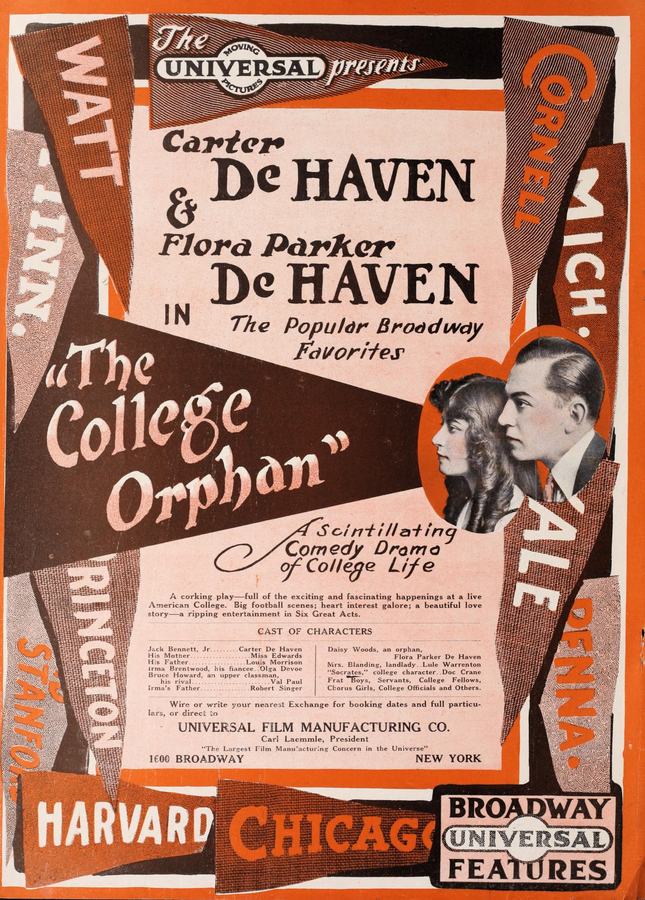
Jack Bennett has been leading a gay life; his father has just received a bill from one of the café proprietors for damage committed by his son and others of a party the night before. He summons the young man and proceeds to lecture him soundly, stating that in the college career upon which he is about to start, his allowance is to be $20 per week. Jack's fiancée is Irma Brentwood, the daughter of his father's partner in business. She, however, prefers Bruce Howard, an upperclassman in the college. It is the plan of the fathers that their children shall marry when Jack finishes college. At school Jack and Bruce are bitter rivals and belong to opposing Greek letter fraternities. Jack is stopping at Mrs. Blanding's boarding house. In Mrs. Blanding's employ is little orphan girl Daisy Woods, who conceives a violent admiration and semi-love for Jack. He scarcely notices her, although he is friendly when by chance he meets her. Jack and his frat brothers plan to attend the theater, but find that the opposing fraternity, including Bruce Howard, have taken possession of the theater and that there is nothing left for them. Howard's crowd starts a rough-house, which ends in their being driven from the theater with a fire hose. Jack and his boys, entering by the stage entrance, arrange with the girls to visit the frat house for a little evening, no evil intended. Disgruntled, Howard's crowd learns of what has happened and of how the other fellows have put it over on them, and they plan to inform the dean of the college. Jack's friends learn of this bit of treachery and smuggle the girls out of the house, while, to cast off suspicion, half of the fellows masquerade as girls. Howard, however, is determined to have revenge, so he arranges with one of the girls a scheme to humiliate his rival. He bribes the girl and smuggles her into Jack Bennett's room at the boarding house, being observed, however, by little Daisy Woods. Jack returns and finds the woman in his room. Jack is expelled and his father disinherits him. Jack is brokenhearted, but acting on the advice of little Daisy Woods, resolves to be a man and make good. Jack, with an eye to the welfare of his little friend, writes a note to his father, explaining that Daisy knows the truth and can explain all. Daisy arrives at the home of Jack's father and tells her story to both his father and his fiancée. His fiancée is apparently unaffected, but the father is repentant and offers forgiveness to his son through Daisy. Jack rejects the offer, stating that he has decided to make good unaided. Mr. Bennett, Jack's father, and Mr. Brentwood, Irma's father, are figuring on a large government contract bid. One evening when calling upon Irma, Bruce Howard sees papers upon which the two fathers have been working lying upon the table, and he at once realizes their value. He slips them inside his pocket, being observed by Daisy, who is acting as Irma's maid. She succeeds in securing the papers without his knowledge and, knowing of their great value, plans to give them to Jack. Jack realizes the value of the papers, and securing an advance from his mother, who has always been his friend, he succeeds in underbidding Howard, as well as his father and partner. He is re-established in the eyes of the fathers, by thus saving the contract. The true story of Howard's duplicity comes out. Irma's father again offers her to Jack, who coldly turns his back upon her and places his arm about the little orphan, Daisy.
Decades after its release, The College Orphan remains a vital piece of the cinematic puzzle. Its influence can be seen in countless modern works, solidifying William C. Dowlan's status as a master of the craft in United States and beyond.